Drill Maintenance
Can You Sharpen Implant Drills?
The short answer is no. Implant drills are precision-tolerance, heat-treated, regulatory-cleared instruments that can't be restored on a bench grinder or through a third-party service without voiding their metallurgy, their tolerance, their FDA/CE conformity, and their manufacturer warranty. Here's what actually happens to a sharpened implant drill, why every major manufacturer instructs disposal at end of life, and what the real alternative is.

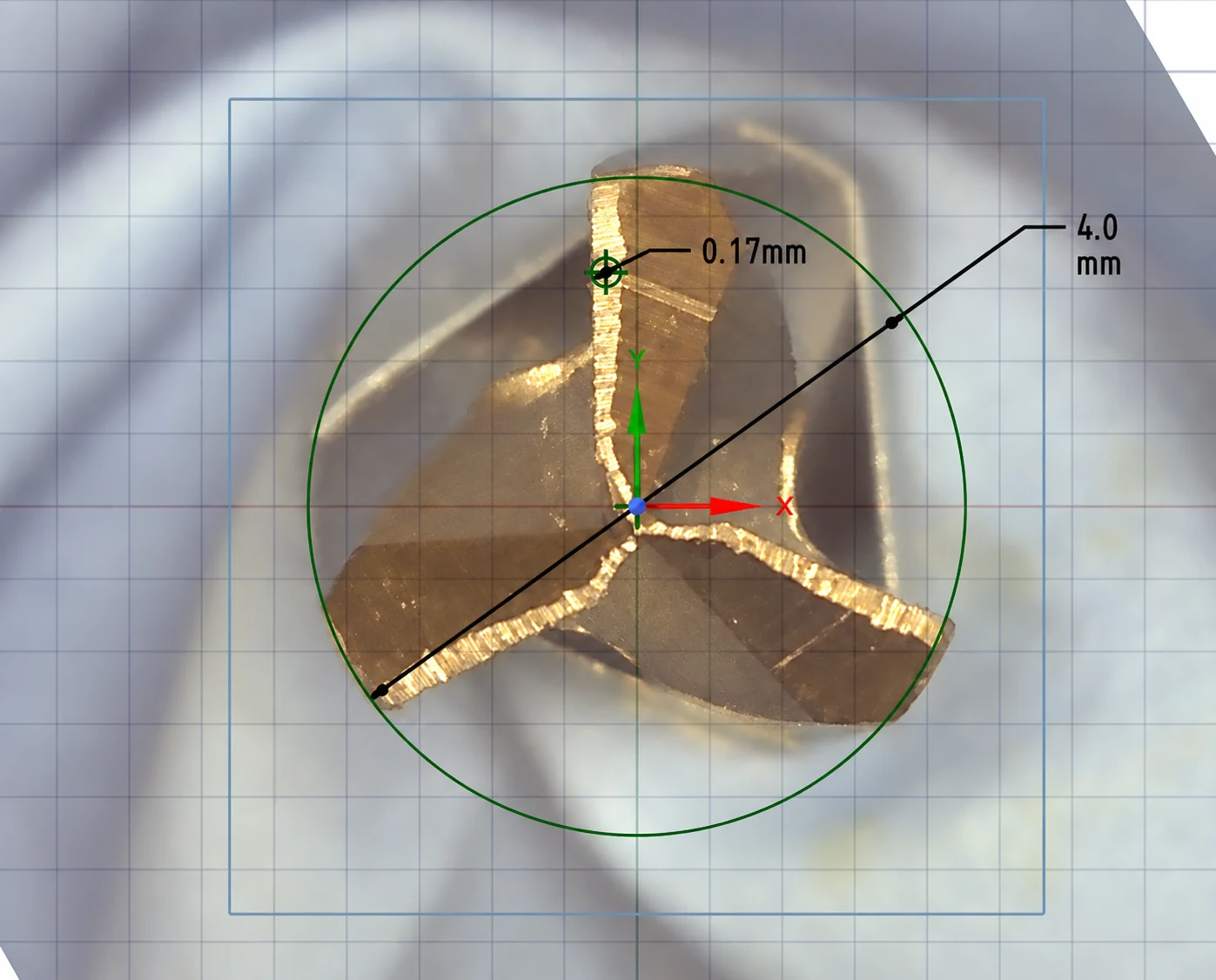
Can implant drills actually be sharpened?
The intuition that a metal cutting tool should be resharpenable is reasonable in most contexts. Kitchen knives, machine-shop drill bits, cabinetmaking chisels - all of these accept a re-ground edge and return to service. Implant drills are different, and the difference sits in three constraints that don’t apply to the tools people typically resharpen at home or with a local service.
1. Dimensional tolerance
An implant drill is a precision instrument. Its outside diameter is held to roughly ±10 microns end-to-end (specific tolerance varies by manufacturer and drill diameter). That’s because the drill’s job is to prepare an osteotomy at a specific diameter matched to a specific implant, and insertion-torque primary stability at 30 to 45 Ncm is measurably sensitive to changes in osteotomy diameter on the order of 10 to 20 microns. A bench grinder or a manual sharpening service holds ±50 to ±200 microns on a good day. Grinding a fresh cutting edge onto a drill also reduces the outside diameter of the drill along the ground segment, because material has been removed. The “sharpened” drill is a smaller drill than the one it started as, and it will prepare a smaller osteotomy than the manufacturer’s drilling chart specifies for the implant being placed.
2. Heat treatment and microstructure
Surgical stainless steel implant drills are heat- treated during manufacture to a specific hardness profile (typically ~200 HV Vickers for the base alloy, with edge-specific treatments that push the cutting geometry harder). The heat treatment establishes the drill’s wear resistance for its stated 20 to 50 osteotomy service life. Bench-grinding operations generate localized frictional heat at the point of contact, and if that heat rises above the alloy’s tempering threshold it re-anneals the edge - softening it. The resulting drill has a bright, freshly-cut edge that looks sharp under inspection but has lost the microstructural hardness that made the original edge durable. In clinical use the drill dulls faster than the factory-new drill it was derived from, because the metallurgy is now different.
3. Regulatory clearance
Implant drills are class II medical devices under 21 CFR 872.4130 in the US and MDR Class IIa in Europe. FDA 510(k) clearance and CE marking are granted to a specific device with specific dimensions, materials, and manufacturing processes. A drill that has been ground down outside the manufacturer’s controlled production environment is not that device anymore. Legally it’s a modified device without independent clearance, which places the practice in the position of using an unapproved medical device on a patient. Every major implant manufacturer’s Instructions for Use (IFU) addresses this directly: drills are labeled with a maximum use count and instructed for disposal at end of life, and there is no manufacturer- approved sharpening or reprocessing pathway.
What happens to a “sharpened” implant drill in clinical use.
Assume a practice sends a batch of dulled steel implant drills to a general instrument-sharpening service and gets them back with a visibly cleaner edge. Three things happen across the next 5 to 10 osteotomies, in this order:
- 1
Osteotomies 1 to 2 - the drill cuts.
The freshly ground edge is aggressive and cuts cleanly. Feels sharper than the factory-new drill did at the end of its service life, which is the sensory feedback that convinces most practices the sharpening worked.
- 2
Osteotomies 3 to 6 - heat rises.
The re-annealed edge softens under bone-cutting load. Cutting efficiency drops off faster than on a factory-new drill because the underlying hardness has been reduced. Osteotomy temperature at the drill-bone interface climbs, and the 47°C thermal necrosis threshold that governs bone healing is now easier to breach.
- 3
Osteotomies 7 to 10 - failure risk.
The drill either dulls into uselessness (the expected outcome) or, if the sharpening removed enough material to reshape the flute geometry, catches in dense bone and fractures. Reported outcomes from practices that have tried this include retained fragments, extended chair time, and occasional emergency retrieval procedures. None of it is priced into the “savings” the sharpening service nominally provided.
The net-of-outcomes economics on sharpened implant drills are worse than the economics on factory-new replacement drills. This is the honest reason no major manufacturer offers a resharpening pathway: the risk transfer from a factory-controlled edge geometry to a field-controlled one is not defensible on either a clinical or a regulatory basis.
What are dentists really searching for when they Google “sharpen implant drills”?
Behind the literal query is a real business problem: implant drills wear out, replacement is expensive, and the annual line item on the practice’s supply invoice keeps growing. That’s the actual thing the practice is trying to solve. Sharpening is one hypothesis (“can I extend the life of the drills I already have?”) that turns out not to work. There are two hypotheses that do work.
Hypothesis A
Accept the replacement cadence, buy fewer drills.
The standard 5-to-8-step implant drilling sequence exists because steel drills need to take small bites through the osteotomy. Fewer drills per case means fewer drills to buy and fewer drills dulling in parallel. The 2-drill implant osteotomy protocol replaces the 5-to-8-step sequence with two drills per site - a cortical drill and a trabecular drill matched to the implant diameter. Even if the material stayed as traditional steel, going from 6 drills per case to 2 reduces the parallel wear surface by two- thirds.
Hypothesis B (the real answer)
Use drills that don’t dull in the first place.
The reason steel implant drills need to be resharpened is because bone can deform surgical stainless steel (~200 HV Vickers). VP10X tungsten carbide sits at ~1,600 HV30 - roughly 8 times harder - and bone physically can’t deform the cutting edge under clinical load. See the citation-backed treatment in Carbide vs. Steel Implant Drills and the deeper safety analysis in Wear-Proof Implant Drills: Myth or Truth?. Solid tungsten carbide implant drills are engineered for unlimited clinical use under the 2-drill protocol, which is why the maintenance protocol is standard sterilization - not resharpening.
The two hypotheses compound. A tungsten carbide 2-drill kit replaces a 6-drill steel sequence and doesn’t dull, which is why the Crown Down implant drill kit is a one-time $3,495 purchase rather than a $3,495 kit plus a $500 to $2,000 annual replacement bill.
What are the three options if your implant drills go dull?
For a practice placing 25 implants a year with a mixed-brand tray (typical general-practice profile), the 5-year math on the three approaches looks like:
| Approach | Clinical risk | Regulatory status | 5-year cost |
|---|---|---|---|
| Sharpen the drills you have | Elevated (heat, tolerance, fracture) | Voided | ~$500 - before priced-in failures |
| Buy factory-new replacement drills | Standard (matches manufacturer envelope) | Maintained | $4,500 to $12,000 |
| Move to Crown Down carbide (no replacement) | Reduced (2 drills, lower heat, no wear) | FDA cleared | $3,495 one-time |
Numbers assume mid-volume mixed-brand practice. Run the exact math for your practice through the implant drill cost calculator.
Frequently asked questions
Quick answers to questions clinicians ask most about this topic.
Stop paying for drills that dull.
The Crown Down 2-drill tungsten carbide kit is a one-time $3,495 purchase that replaces both the steel drill sequence and the annual replacement cycle. Universal implant-system compatibility, FDA cleared, engineered for unlimited clinical use.
Keep reading
Related reading
Explore related pages on the Crown Down dental implant drilling kit, protocol, and clinical science.
Drill Wear
Why Implant Drills Dull
The science of steel drill wear, and how carbide resists routine dulling.
Read moreClinical Analysis
Wear-Proof Implant Drills: Myth or Truth?
Deep clinical analysis of tungsten carbide implant drills, the safety problem of a conventional ascending drilling sequence, and why the Crown Down architecture is required to make the material safe.
Read moreImplant Drill Kit
Tungsten Carbide Implant Drill Kit
What's inside the kit, the spec sheet, and the protocol it replaces.
Read more