Neodent Compatible
Crown Down for Neodent. The Compatible Drill Kit.
You place Helix GM, Drive GM, Alvim, or Titamax in Latin American, European, or global general-practice implant cases. Your Neodent drills wear out on the same 20 to 50 osteotomy cadence as every steel tray, and even at Neodent's accessible per-drill pricing the ongoing replacement math compounds across a 5-year window. Crown Down is a tungsten carbide drilling kit that maps to Neodent's published osteotomy specifications, uses two drills per site instead of three to five, and doesn't require scheduled replacement.




Which Neodent lines does the kit cover?
Crown Down publishes a validated drilling chart for the Grand Morse (GM) platform, and the same universal drill geometry prepares the osteotomy for every other Neodent implant family. For Titamax CM, Alvim, and Facility, the drilling-chart PDF is issued on demand once we confirm the implant diameters and depths your practice actually places.
Grand Morse (GM) - Helix GM & Drive GM
Neodent’s flagship platform, with the proprietary internal-conical Grand Morse abutment connection. Helix GM is the apically tapered variant used in most extraction-and-immediate protocols; Drive GM is the parallel-walled variant used in healed-ridge cases. Drilling chart covers Ø 3.5, 3.75, 4.0, 4.3, 5.0, and 6.0 mm implant diameters at Neodent’s standard lengths.
Titamax CM
Neodent’s earlier-generation cortical-drilled line, still widely placed in Latin America (particularly Brazil) with a large installed base of practices. Drilling chart maps the 2-drill protocol to the diameters Titamax CM specifies. Available on request - book a call below.
Alvim & Facility
Alvim is the aesthetic-zone tapered line with the Grand Morse connection, tuned for anterior soft-tissue management. Facility is the one-piece narrow-diameter implant for atrophic ridges where a two-piece implant can’t seat safely. Both share the universal Crown Down drill geometry.
The universal handpiece interface and the tungsten carbide drill material don’t change across Neodent lines - only the mapping to each line’s specific osteotomy diameters does. That mapping is a chart, not a hardware change. Latin American practices routinely place a mix of Titamax CM (installed base) and Helix GM (current line) out of the same tray; one Crown Down kit covers both, and if that same practice also places Straumann BLC (increasingly common in Southern Europe and premium urban markets), the same tray handles that too. See the dedicated Straumann page for BL / BLC mapping.
Compatibility mappings on this page were last verified against Neodent’s published surgical protocols on September 1, 2026. Independent verification for a specific Neodent line is available on request via booking.
What actually changes on a Neodent case with Crown Down.
The osteotomy is prepared to the same final diameter and depth Neodent specifies. Primary stability targets stay the same, implant selection stays the same, restorative components stay the same. The Grand Morse internal-conical interface between the implant body and the abutment is unaffected because it’s an implant-abutment feature, not a drilling feature. What changes is the drill sequence itself: one cortical pass with a tungsten carbide drill matched to the implant diameter, then one trabecular pass with the paired second drill. Two drills per site instead of the Pilot → 2.8 mm → intermediate → final → (optional cortical or bone tap) sequence in a Neodent surgical kit. The full technique is documented on the 2-drill protocol page.
Neodent Grand Morse steel kit
- 1. Round bur or lance drill (crestal marking)
- 2. Pilot Drill Ø 2.0 mm
- 3. Twist Drill Ø 2.8 mm
- 4. Intermediate twist drills (as diameter increases)
- 5. Final Twist Drill matched to GM implant diameter
- 6. Cortical Drill or Bone Tap (dense-bone cases only)
3 to 5 drills per site, 800 to 1,200 RPM, continuous saline irrigation. Replaced roughly every 20 to 50 osteotomies as the cutting edge dulls. Cortical drill or bone tap adds a step in D1 or dense D2 bone.
Crown Down protocol on the same case
- 1. Cortical drill matched to GM implant diameter
- 2. Trabecular drill (paired partner)
2 drills, 200 RPM, no saline dependency. Solid tungsten carbide, engineered for unlimited clinical use. Osteotomy is prepared to the exact final diameter Neodent specifies for the chosen Grand Morse implant. Dense-bone management moves from a separate cortical drill or bone-tap step to the two-material cortical/trabecular geometry.
Surgeons switching a Neodent workflow to Crown Down report that the biggest visible change is on the tray. A standard Neodent Grand Morse surgical kit lays out 6 to 10 sequenced drills across the GM diameter range, plus optional cortical drill and bone tap. The Crown Down tray shows one cortical drill and one trabecular drill for the diameter being placed, plus one set of coded depth stoppers. For a high-volume Latin American practice placing 40+ implants a month across mixed Titamax + Helix GM inventory (a very common workflow), the reduction in drill-handovers per case is meaningful across a full surgical day.
5-year cost: Neodent steel kit vs Crown Down.
Neodent is positioned within the Straumann Group as the value-tier brand, and the per-drill replacement pricing reflects that (roughly $40 to $100 per drill, among the most accessible in the industry). The drills still dull on the same clinical cadence as every other steel kit, though, and the high implant-placement volumes typical in Neodent’s core Latin American markets mean the annual replacement spend compounds meaningfully. The 5-year math tightens even at Neodent’s more accessible pricing.
| Cost line | Neodent steel kit | Crown Down |
|---|---|---|
| Initial kit purchase | $600 to $1,500 | $3,495 |
| Drill replacement / year | $400 to $1,000 | $0 |
| 5-year total | $2,500 to $6,500 | $3,495 |
Ranges depend on annual case volume and replacement cadence. Neodent’s break-even against Crown Down typically lands between year 4 and year 6 for a mid-volume general practice, and closer to year 3 for the 40+ implants/month Brazilian workflows where drill replacement compounds fastest. The dedicated drill cost calculator runs the exact numbers for your case volume and current Neodent invoice pricing.
The handpiece question
Same handpiece, same tray, same case flow.
Crown Down drills use a standard latch-type implant contra-angle handpiece interface. The Morse taper 1.5° on the drill shank is a 4.0 mm well for depth-stopper mounting, and the shank is 18 mm long. This is the same open-standard interface that Neodent surgical drills use (and Straumann, Nobel Biocare, Zimmer Biomet, Astra Tech, BioHorizons, and every other major implant system). Any standard contra-angle handpiece on your Neodent tray already accepts Crown Down drills without an adapter.
No proprietary driver, no color-coded push-button retainer requirement, no reprocessing change. The kit ships, you sterilize it, and it replaces the Neodent drill sequence on the tray you already have. The broader surgical implant kit page documents the freehand tray configuration; the guided implant drill kit page covers coded 3D depth stoppers for template-based Neodent cases.
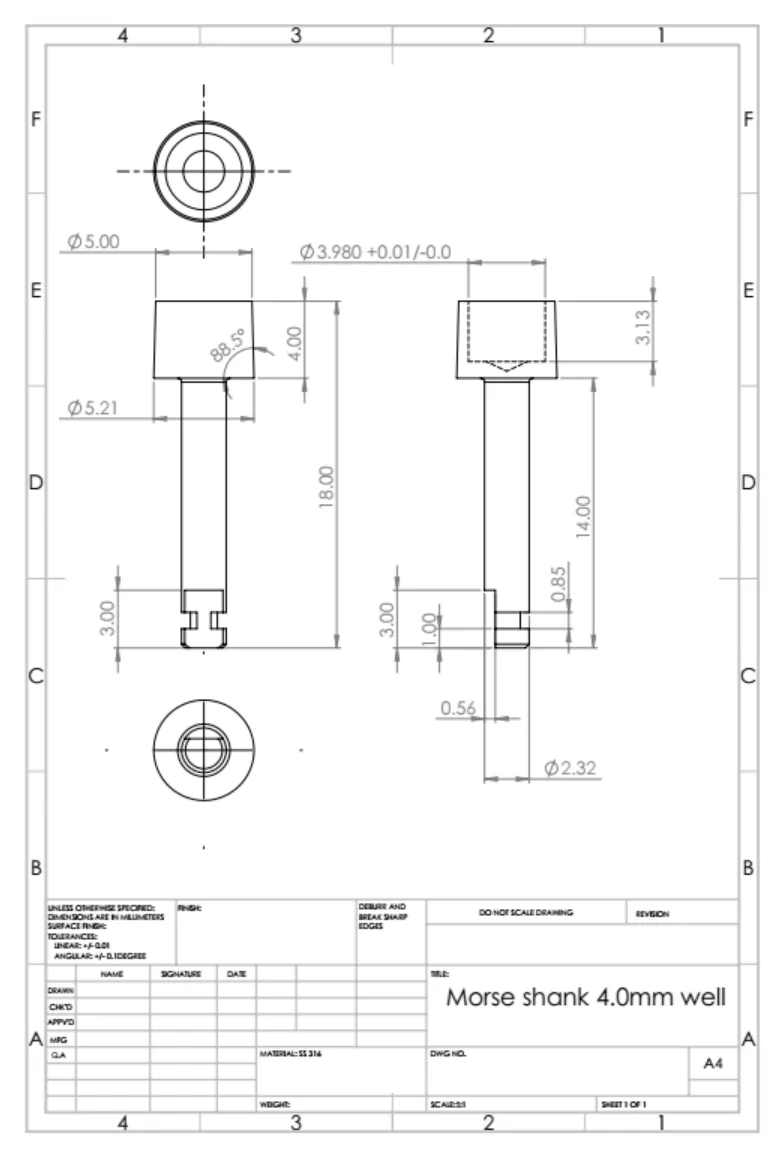
Standard latch contra-angle handpiece interface; Morse taper on the drill shank (4.0 mm well, 18 mm length) mounts the depth stopper.
Frequently asked questions
Quick answers to questions clinicians ask most about this topic.
See the drilling chart for your Neodent line.
Download the Grand Morse drilling chart, request the Titamax CM, Alvim, or Facility mapping, book a call for your specific case volume, or run the 5-year cost math against your current Neodent invoice pricing.
Keep reading
Related reading
Explore related pages on the Crown Down dental implant drilling kit, protocol, and clinical science.
Compatibility
Universal Implant System Compatibility
Drilling charts and user manuals for Nobel, Straumann, Zimmer, Astra Tech, Neodent, Camlog, and 20+ more.
Read moreCost Calculator
Implant Drill Kit Cost Calculator
Interactive 5-year cost comparison: your case volume vs a traditional steel kit vs Crown Down.
Read moreProduct Catalog
Crown Down 2026 Catalog
Every kit, drill, SKU, and stopper in one printable PDF reference.
Read more