Thermal Science
The Hidden Thermal Problem in Guided Implant Surgery
Guided surgery improved accuracy, but it introduced a cooling problem standard irrigation can’t fully solve. Here is what the literature says, why workarounds fall short, and how heat conduction changes the equation.

Why does guided implant surgery have a cooling problem?
Guided implant surgery is now the standard of care in a growing share of implant practices. CAD/CAM planning, surgical guides, and sleeve systems all improved the accuracy and predictability of implant placement. What they did not improve is heat management at the osteotomy.
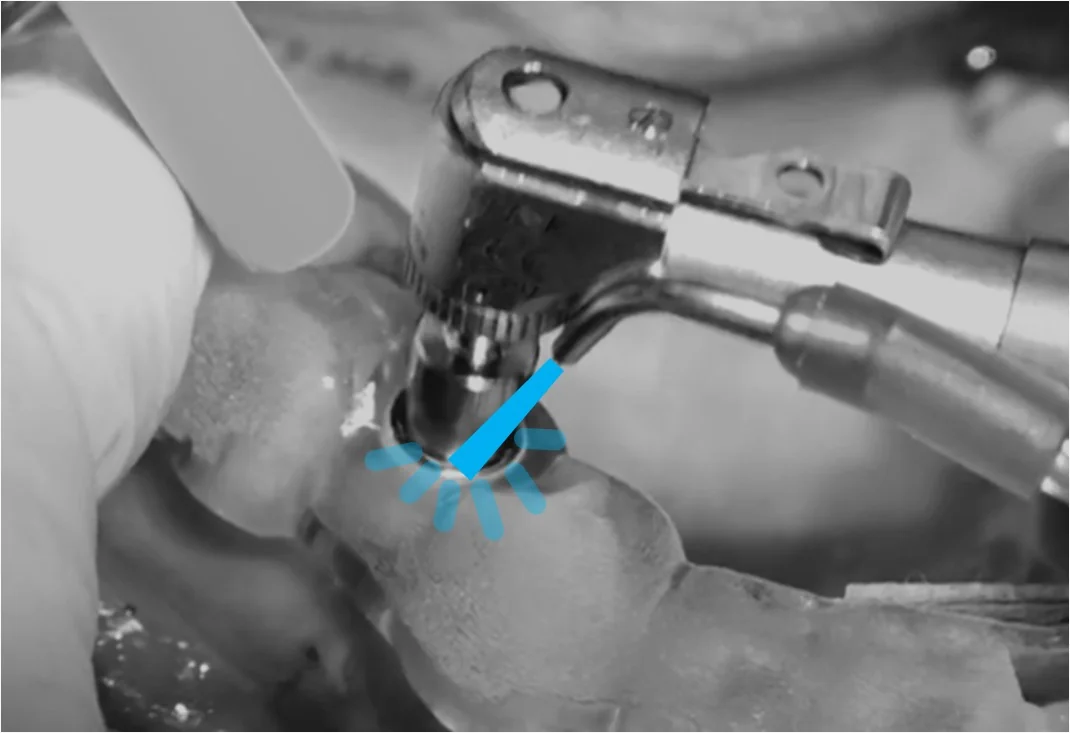
The mechanical reason is straightforward. A guide tube is a narrow metal or polymer sleeve that constrains the drill axially so it cannot deviate from the planned trajectory. Saline irrigation is delivered from outside the sleeve, either as an external spray or from a physiodispenser nozzle. To reach the cutting edge of the drill inside the osteotomy, the saline must travel down the gap between the drill shaft and the sleeve, then continue past the crestal cortical bone, before it ever touches the working tip.
In practice, most of the coolant runs off without ever reaching the cutting interface. Several in-vitro studies have measured this directly: guided drilling produces peak osteotomy temperatures that are 3 to 6°C higher than the same drill used freehand in the same bone, at the same RPM, with the same irrigation flow rate. That delta is enough to push peak temperature above the threshold for thermal injury in dense cortical bone.
What temperature does bone actually tolerate during implant drilling?
Eriksson and Albrektsson established the canonical threshold in 1983: bone exposed to 47°C for 60 seconds undergoes irreversible thermal osteonecrosis. Later research narrowed it further, showing that sustained temperatures in the 42 to 44°C range can already impair osseointegration even without overt cell death.
For a full review of the 47°C threshold, see our deeper article on heat during implant drilling. The short version: thermal injury is dose-dependent. Peak temperature matters, but so does duration at temperature. A drilling protocol that briefly spikes to 48°C is far less injurious than one that holds 45°C for two minutes.
Guided surgery is the most demanding cooling scenario in implant dentistry. Cortical bone is the hardest, densest, most thermally insulating zone of the osteotomy. Friction is highest there. And the sleeve restricts irrigation precisely at the moment the drill is engaging that cortical bone. The result is a thermal pulse that can clear 47°C with copious external irrigation still running.
What are the two common workarounds for guided-surgery heat, and why does neither fully solve it?
Drill manufacturers know the sleeve cooling problem exists. Two approaches dominate the market response.
Slotted-shaft guided drills
Many guided-drill product lines machine longitudinal slots into the drill shaft. The idea is that saline flowing along the gap between the drill and the sleeve can enter the slots and travel further down the drill toward the cutting edge. This works in part. The slots improve flow distribution along the drill body.
The clinical limit is geometric. Most of the irrigation still passes the drill shaft entirely and runs off outside the osteotomy rather than into the cutting interface inside the bone. The slots help, but they do not redirect bulk flow into the osteotomy. They improve cooling along the upper part of the drill, where heat is less of a problem, more than at the apex, where the actual heat generation happens.
Internal-irrigation drills
A second class of guided drill carries an internal saline channel. Coolant is delivered through the drill body itself and exits at or near the cutting edge, bypassing the sleeve restriction entirely. On paper this is the cleanest solution.
In practice the line pressure available from standard implant physiodispensers limits how much saline actually reaches the cutting edge through a narrow internal channel. Pressure management, channel patency, and the additional cost and sterilization complexity of internally-irrigated drills mean adoption has been uneven. The approach reduces peak temperature compared with external irrigation alone, but it has not eliminated the underlying problem in dense bone.
Bottom line
Both workarounds treat the symptom (insufficient saline at the cutting edge) rather than the cause (the drill material itself traps heat in the bone). A drill that conducts heat away from the cutting edge faster than friction can build it up at the edge solves the problem at its source.
A different approach: remove heat through the drill, not around it
The Crown Down approach reframes the problem. Instead of asking how to push more saline through a restricted sleeve, it asks how to keep heat out of the bone in the first place. Three levers contribute, and together they make irrigation an optional adjunct rather than the primary cooling mechanism.
Lever 1: material thermal conductivity
Solid tungsten carbide has a thermal conductivity of 110 W/m·K. Stainless steel sits at roughly 18 W/m·K. A carbide drill pulls heat away from the cutting edge into the drill body and eventually out of the osteotomy roughly six times faster than steel. That alone changes the thermal balance at the cut.
Lever 2: edge sharpness over time
Friction is what generates heat at the osteotomy. A sharper drill cuts cleanly with less downward force and less friction; a dull drill grinds, plows, and generates substantially more heat per pass. Stainless steel drills lose their cutting edge measurably after about 20 osteotomies. Tungsten carbide at a Vickers hardness of roughly 2,600 HV is dramatically more wear-resistant, and in Crown Down bench testing the cutting edge showed no measurable wear across the tested cycle counts. The clinical intent is simple: reduce the chance that a shared, aging steel drill arrives at the sleeve already dull.
Lever 3: low rotational speed
Most implant drilling protocols call for 800 to 1,500 RPM with copious irrigation. Crown Down drills cut efficiently at around 200 RPM. At lower RPM the same volume of bone is removed with fewer revolutions of the cutting edge against the cortical wall, which means less friction over a longer time window, which means less heat per unit time. Low speed only works with a drill that cuts cleanly at low speed, which is where the carbide hardness and edge geometry pay off.
Lever 4: fewer passes per site
Conventional implant osteotomy protocols sequence 5 to 8 drills per site. Each pass is an opportunity to add thermal load. The Crown Down 2-drill protocol prepares each osteotomy with one cortical drill and one trabecular drill. Cumulative drilling time per site drops by 60 to 75%, which compresses the heat exposure window the bone has to recover from.
Practical implications for guided cases
What does this mean for a clinician planning a guided implant case today, with conventional drills?
- 1Treat irrigation as a partial solution, not a complete one. External irrigation through a guide sleeve does not deliver the cooling flow rate it does in freehand surgery. Plan accordingly, especially in D1 and D2 bone.
- 2Track drill life carefully. A dull guided drill in a high-density mandible is the worst possible case for thermal injury. If you reuse drills, sterilize them at a defined cycle count and rotate them out before the edge degrades.
- 3Slow the drill down where the protocol allows. Lower RPM generates less friction per unit time. The trade-off is preparation time, but in dense bone the thermal margin is usually worth it.
- 4Consider drill material when you next renew the kit. The single biggest variable in osteotomy heat is the drill material. Carbide drills are sharper for longer and conduct heat better than any stainless steel formulation. The cumulative effect across a guided practice is substantial.
See the Crown Down difference
One kit, two drills per site, and a wear-proof carbide system designed to eliminate routine drill replacement.
The Crown Down protocol for guided cases
Crown Down drills are designed to work without external irrigation when used per protocol. In guided surgery the value compounds because the sleeve cooling restriction is exactly the variable the carbide conductivity is built to bypass. The drill carries heat out of the osteotomy on its own thermal gradient; the saline line is no longer the limiting factor.
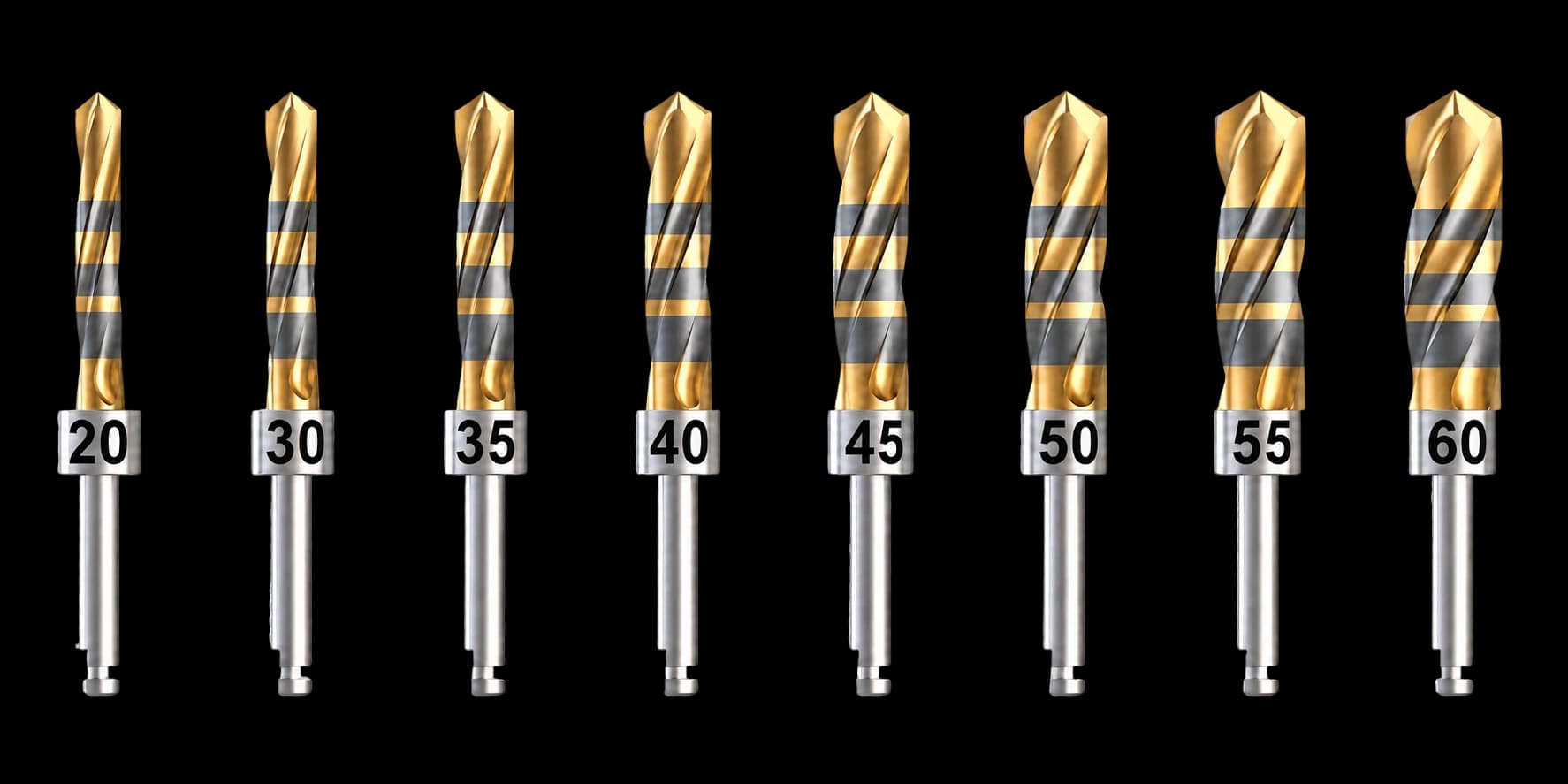
Two drills per site at 200 RPM, with the same color-coded depth-stopper system used freehand. Universal compatibility with all major guided-surgery sleeve systems, so the kit drops into an existing guided workflow without changing the planning software, the template, or the abutment. For clinicians who have been navigating the sleeve cooling problem with longer pause cycles, external irrigation upgrades, or repeat investments in single-use drills, the carbide+low-speed approach removes the underlying constraint instead of working around it.
Frequently asked questions
Quick answers to questions clinicians ask most about this topic.
References
- Eriksson AR, Albrektsson T. Temperature threshold levels for heat induced bone tissue injury: a vital-microscopic study in the rabbit. J Prosthet Dent. 1983;50(1):101-107.
- Misir AF, Sumer M, Yenisey M, Ergioglu E. Effect of surgical drill guide on heat generated from implant drilling. J Oral Maxillofac Surg. 2009;67(12):2663-2668.
- Marković A, Šćepanović M, Kaľan D, et al. Heat generation during implant placement in low-density bone: effect of surgical technique, insertion torque and implant macro design. Clin Oral Implants Res. 2013;24(7):798-805.
- Augustin G, Davila S, Mihoci K, Udiljak T, Vedrina DS, Antabak A. Thermal osteonecrosis and bone drilling parameters revisited. Arch Orthop Trauma Surg. 2008;128(1):71-77.
- Sannino G, Barlattani A. Mechanical evaluation of an implant- abutment self-locking taper connection: finite element analysis and experimental tests. Int J Oral Maxillofac Implants. 2013;28(1):e17-e26.
Keep reading
Related reading
Explore related pages on the Crown Down dental implant drilling kit, protocol, and clinical science.
Heat & Thermal
Heat During Implant Drilling
Causes, the 47°C threshold, and how drill material affects temperature.
Read moreDrilling Protocol
Low-Speed Implant Drilling
Why RPM alone is not enough: cutting capacity, drill material, and the 2-drill Crown Down protocol at 200 rpm.
Read moreSurgical Kit
Surgical Implant Kit for Guided Surgery
8 carbide drills, depth stoppers, and universal compatibility.
Read more