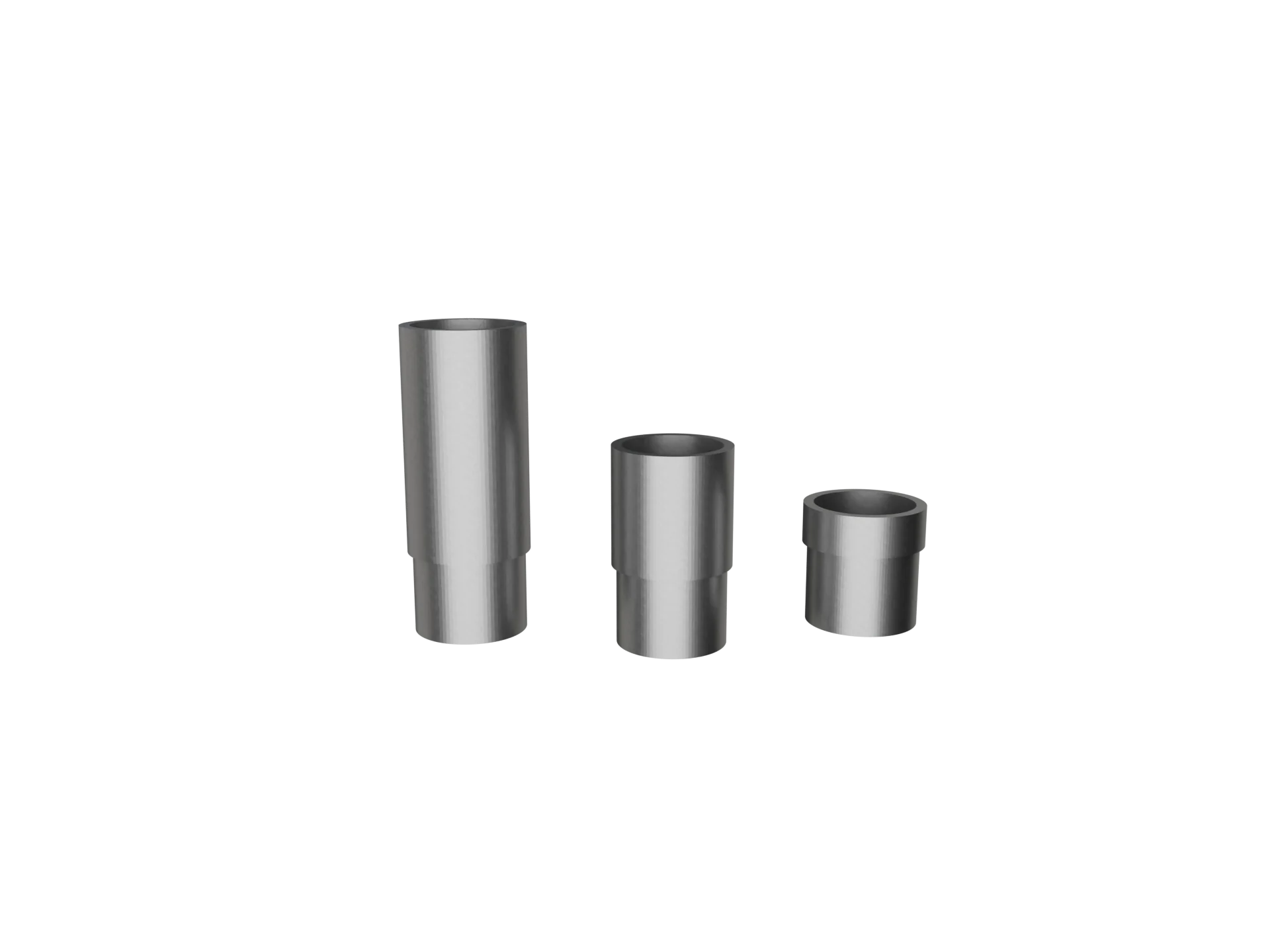
Guided Surgery Accessory
Crown Down 3D Drill Stoppers
A purpose-built drill stopper that locks onto the drill shank to control implant osteotomy position in all three dimensions.
- Surgical-grade alloy
One-time investment|Ships worldwide|Typically Section 179-eligible in the US
Choose length
- Reply within 1 business day
- 60-day trial
- Ships worldwide
FDA 510(k) cleared Class II dental device (21 CFR 872.4130). Supplied non-sterile, reusable, professional use only. Read the instructions for use before use. Manufactured by Stomatotech Inc., Canada.
- FDA cleared
- Universal compatibility
- Ships worldwide
CD-STPSurgical-grade alloyFDA clearedCrown Down 15 mm and 20 mm tungsten carbide drills
The Crown Down 3D drill stopper attaches securely to the drill shank to help control drill position in all three dimensions during guided implant surgery. It works with the Crown Down 2-drill protocol and standard surgical guides for predictable 3-dimensional control during osteotomy preparation. Each Crown Down kit ships with two stoppers (#1 and #2); additional and replacement stoppers are available individually in 8, 10, and 12 mm.
- 3-dimensional drill control during guided osteotomy preparation
- Available in 8, 10, and 12 mm working depths
- Inner tube Ø 5.5 mm, tube height 4.0 mm, offset 9 mm
- Compatible with the Crown Down 15 mm and 20 mm drilling kits
- Designed for use with standard surgical guides
- Steam autoclavable per the Instructions for Use
- FDA cleared
Specifications
- SKU
- CD-STP-L008 (8 mm), CD-STP-L010 (10 mm), CD-STP-L012 (12 mm)
- Available Depths
- 8 mm, 10 mm, 12 mm
- Inner Tube Diameter
- Ø 5.5 mm
- Tube Height
- 4.0 mm
- Tube Offset
- 9 mm
- Application
- Guided implant surgery, 3-dimensional drill control
- Compatibility
- Crown Down 15 mm and 20 mm tungsten carbide drills
- Sterilization
- Validated steam autoclave (pre-vacuum or gravity) per IFU
- Regulatory
- FDA cleared
Clinical Use Cases
Fully Guided Implant Surgery
Predictable depth and position control during fully guided osteotomy preparation, paired with surgical guides.
Mixed Workflows
Add stoppers to the Crown Down 2-drill kit when a specific case calls for guided control on top of the standard freehand workflow.
Clinical context
Why 3-dimensional drill control matters.
Most implant drill stoppers control one axis: apical depth. They prevent over-drilling past the planned implant length, and that is useful. But an implant osteotomy is not a one-dimensional problem. The drill can still drift in angulation and translate in position, and either error puts the implant where the treatment plan did not.
1. Depth
The apical limit of the osteotomy. A miscalculated depth risks perforating the inferior alveolar nerve, the maxillary sinus floor, or the lingual cortical plate of the mandible.
2. Angulation
The drill axis relative to the planned implant trajectory. Even a small angular deviation compounds with depth, and at the apex a 5° drift can place the drill several millimeters off the planned path.
3. Position
Mesio-distal and bucco-lingual translation of the osteotomy entry point. Position drift is the most common cause of adjacent-root contact and asymmetric emergence profiles in anterior cases.
The Crown Down 3D stopper engages the drill shank above the cutting flutes and registers against the surgical guide on a rigid 4 mm tube. That seats the drill in a known position, constrains it to the planned angulation, and bottoms out at the planned apical depth in a single mechanical reference. The result is depth, angulation, and position locked together as one registration event, which is what 3-dimensional control means in this context.
For freehand workflows the stoppers are optional. For any case running a 3D-printed surgical guide, the stoppers turn the guide from a positional reference into a true mechanical envelope around the osteotomy. They are compatible with thermoplastic, SLA, and SLS surgical guides; the only requirement is a guide sleeve sized to receive the 5.5 mm tube.
Frequently Asked Questions
Ready to bring 3D stoppers into your practice?
Book a call to walk through pricing, the 2-drill protocol, and how this fits your workflow.
Keep reading
Related reading
Explore related pages on the Crown Down dental implant drilling kit, protocol, and clinical science.
15 mm Kit
Crown Down 15 mm Implant Drilling Kit
8 solid tungsten carbide drills in 15 mm length for standard implant osteotomies.
Read more20 mm Kit
Crown Down 20 mm Implant Drilling Kit
8 solid tungsten carbide drills in 20 mm length for longer osteotomies and deep guided cases.
Read moreCompatibility
Universal Implant System Compatibility
Drilling charts and user manuals for Nobel, Straumann, Zimmer, Astra Tech, Neodent, Camlog, and 20+ more.
Read more