Implant Drilling Explained
The Implant Drill Guide Types, RPM & Protocols
Most surgical cassettes on the market follow the same playbook: a sequence of 5 to 8 stainless steel drills per implant, used with copious saline irrigation. Crown Down is a newer approach. Here’s what implant drilling instruments are, how the traditional protocol works, and what Crown Down does differently.

What is a dental implant drill, and how does it work?
Before getting into the comparison, the basics. A dental implant drill is a precision surgical instrument that prepares the bone cavity (the osteotomy) that will receive an implant fixture. Implant drills cut through dense cortical bone at the bone surface and softer trabecular bone underneath, shaping a cavity with the right diameter and depth for the implant to seat with primary stability.
Every implant drill, regardless of brand or system, has three parts:
1. The working tip
The cutting edges that contact bone. Diameter and flute geometry change by drill purpose.
2. The shaft
The long drill body, usually laser-marked with depth lines so the operator can read penetration depth from outside the mouth.
3. The handpiece interface
The proximal end fits into a contra-angle dental handpiece using a standardized latch.
How does the traditional implant drilling protocol work?
The protocol used by the majority of implant systems on the market (Nobel Biocare, Straumann, Zimmer, MIS, Camlog, Neodent, and most others) was developed in the 1980s and has evolved incrementally since then. The shape of the protocol is consistent across brands.
Five to eight drills per implant site
The traditional sequence walks the osteotomy diameter up in small steps: pilot drill (about 2.0 mm to mark trajectory), then a series of twist drills of progressively increasing diameter, then a final-shape drill matching the implant geometry, and sometimes a cortical countersink at the end. Each drill is a separate pass.
Stainless steel construction
Most kits ship stainless steel drills, sometimes with a hard surface coating (TiN, ZrN, DLC) to slow edge wear. Stainless steel has a Vickers hardness of about 600 HV and a thermal conductivity of 18 W/m·K. The edge dulls measurably after roughly 20 osteotomies, and the steel body holds heat at the cutting interface rather than conducting it away.
High-speed drilling with continuous saline irrigation
Traditional protocols run drills at 600 to 2,000 RPM depending on bone density: lower speeds in dense cortical bone (D1, anterior mandible) and higher speeds in soft trabecular bone (D4, posterior maxilla). Continuous external irrigation with chilled sterile saline is mandatory throughout the procedure to keep osteotomy temperatures below the 47°C thermal-necrosis threshold.
Drill replacement is part of the operating cost
Because the steel edge wears, manufacturers recommend retiring drills after roughly 20 to 50 uses (some systems specify a single-patient or single-case use). Replacement drills are a recurring line item on the practice’s budget.
How is the Crown Down approach different from a conventional drilling kit?
Crown Down is not a variant of the traditional kit. It’s a different system built on different material science and a different drilling protocol. The clinical outcome (a primary- stable implant) is the same. The path to it changes.
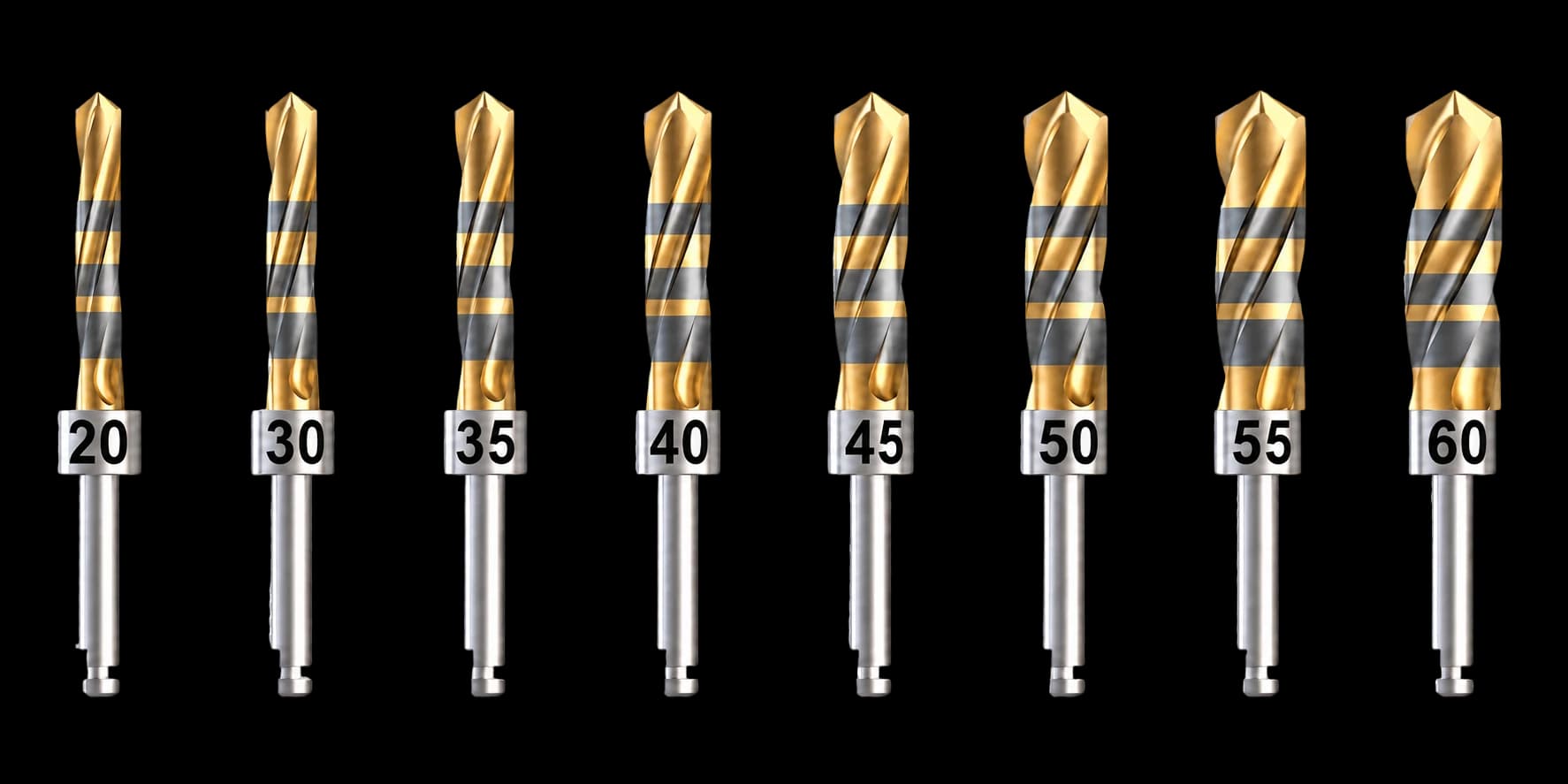
Two drills per site
Each implant osteotomy is prepared with two drills: a cortical drill matched to the implant diameter (drill #1, clears the dense crestal bone layer) and a trabecular drill that is slightly undersized (drill #2, prepares the cancellous zone for intentional bone compression and primary stability). The mechanism is explained in detail in the 2-drill protocol guide.
Solid tungsten carbide construction
Crown Down drills are solid tungsten carbide rather than steel. Carbide has a Vickers hardness of about 2,600 HV (more than four times steel) and a thermal conductivity of 110 W/m·K (about six times steel). In plain terms: the cutting edge stays sharp far longer, and the drill body actively conducts friction heat away from the osteotomy rather than trapping it at the cut. The material science is covered in depth in carbide vs steel implant drills.
Low-speed drilling without forced saline irrigation
The protocol runs at 200 RPM across all bone densities. Lower RPM means less friction generated per second, and carbide’s high thermal conductivity removes that friction heat without relying on saline to wash it away. The same approach is what makes the system practical for guided implant surgery, where guide sleeves restrict saline flow to the cutting edge.
No scheduled drill replacement
Independent bovine-rib testing has documented Crown Down drills holding a sharp cutting edge across 1,000 osteotomy cycles without measurable wear. There is no scheduled replacement interval. The kit is purchased once.
Ready to look at product pages? See the transactional implant drill kit, the surgical implant kit (freehand and mixed workflows), or the guided implant drill kit (template-based cases). The broader dental implant drills page covers the two carbide instruments themselves.
How they differ, side by side
Five practical differences a clinician evaluating the two approaches will feel in day-to-day use.
| Variable | Traditional drill sequence | Crown Down system |
|---|---|---|
| Drills per implant site | 5 to 8 | 2 |
| Drill material | Stainless steel (sometimes coated) | Solid tungsten carbide |
| Operating RPM | 600 to 2,000 (varies by bone density) | 200 across all bone densities |
| Saline irrigation | Continuous external (mandatory) | Not required; carbide conducts heat away |
| Drill lifespan (osteotomies) | ~20 to 100 then retired | 1,000+ documented, no retirement |
| Cost structure | Lower upfront, recurring replacement | Higher upfront, no scheduled replacement (run the numbers) |
| Implant system compatibility | Usually locked to one manufacturer | Universal (20+ systems, including Nobel, Straumann, Zimmer) |
Why these differences matter clinically
Heat at the osteotomy. Every drill pass adds friction heat. Fewer drills + lower RPM + higher thermal conductivity means less cumulative thermal load on the bone, and a wider margin from the 47°C necrosis threshold. The thermal argument is covered in detail in heat during implant drilling.
Case time. Two drills + no tray changes between diameters cuts the drilling portion of the procedure by roughly 60 to 75% versus a 5-to-8-drill sequence.
Inventory and budget. A practice running traditional steel kits maintains a rotating inventory of replacement drills and budgets for them as a recurring line item. A carbide system shifts that spend to a single upfront purchase.
Guided implant surgery. Guide sleeves restrict saline flow to the cutting edge, so a protocol that depends on irrigation runs hotter inside a guide. A material that conducts heat through the drill body rather than washing it away with saline removes that dependency.
What implant drill sizes and diameters are used in both systems?
Implant drill diameter is dictated by the implant being placed, not by the protocol that prepares the osteotomy. Both traditional kits and Crown Down cover the same diameter range. The difference is how many drills it takes to get there.
| Implant diameter | Approximate final drill diameter | Typical clinical use |
|---|---|---|
| 3.0 to 3.5 mm | ~2.8 to 3.2 mm | Narrow ridges, lower incisors, maxillary laterals |
| 3.75 to 4.5 mm | ~3.5 to 4.0 mm | Standard cases, posterior molars, anterior teeth |
| 5.0 to 6.0 mm | ~4.5 to 5.5 mm | Wide molars, immediate placement in fresh sockets |
Diameters are illustrative. Always verify against the implant manufacturer’s drilling chart for the specific fixture being placed.
Which drilling approach fits which practice?
Both systems can produce successful implant osteotomies in competent hands. The decision is about fit, not correctness.
A traditional kit fits a practice that...
- Is built around a single implant brand and wants the manufacturer’s native drilling chart in the tray
- Prefers lower upfront cost with replacement cost spread across years
- Has clinicians trained extensively on the conventional multi-drill sequence
Crown Down fits a practice that...
- Places implants across multiple manufacturer systems and wants one tray for all of them
- Prefers a single upfront purchase to a recurring drill- replacement budget
- Does meaningful volume in guided surgery and wants to remove the sleeve-irrigation bottleneck
- Values shorter case time and lower osteotomy heat enough to invest in the upgrade
See the Crown Down difference
One kit, two drills per site, and a wear-proof carbide system designed to eliminate routine drill replacement.
Frequently asked questions
Quick answers to questions clinicians ask most about this topic.
Keep reading
Related reading
Explore related pages on the Crown Down dental implant drilling kit, protocol, and clinical science.
Cost Calculator
Implant Drill Kit Cost Calculator
Interactive 5-year cost comparison: your case volume vs a traditional steel kit vs Crown Down.
Read moreCortical Drill
Cortical Drill for Dental Implants
Drill #1 in the Crown Down 2-drill protocol: matched per implant diameter, used first to clear dense crestal bone.
Read moreProduct Catalog
Crown Down 2026 Catalog
Every kit, drill, SKU, and stopper in one printable PDF reference.
Read more