Drilling Technique
The Crown Down Technique A 2-Drill Implant Osteotomy
A top-down osteotomy protocol that completes implant site preparation up to 4× faster, with better thermal control, fewer instruments, and predictable primary stability.

What is the Crown Down technique?
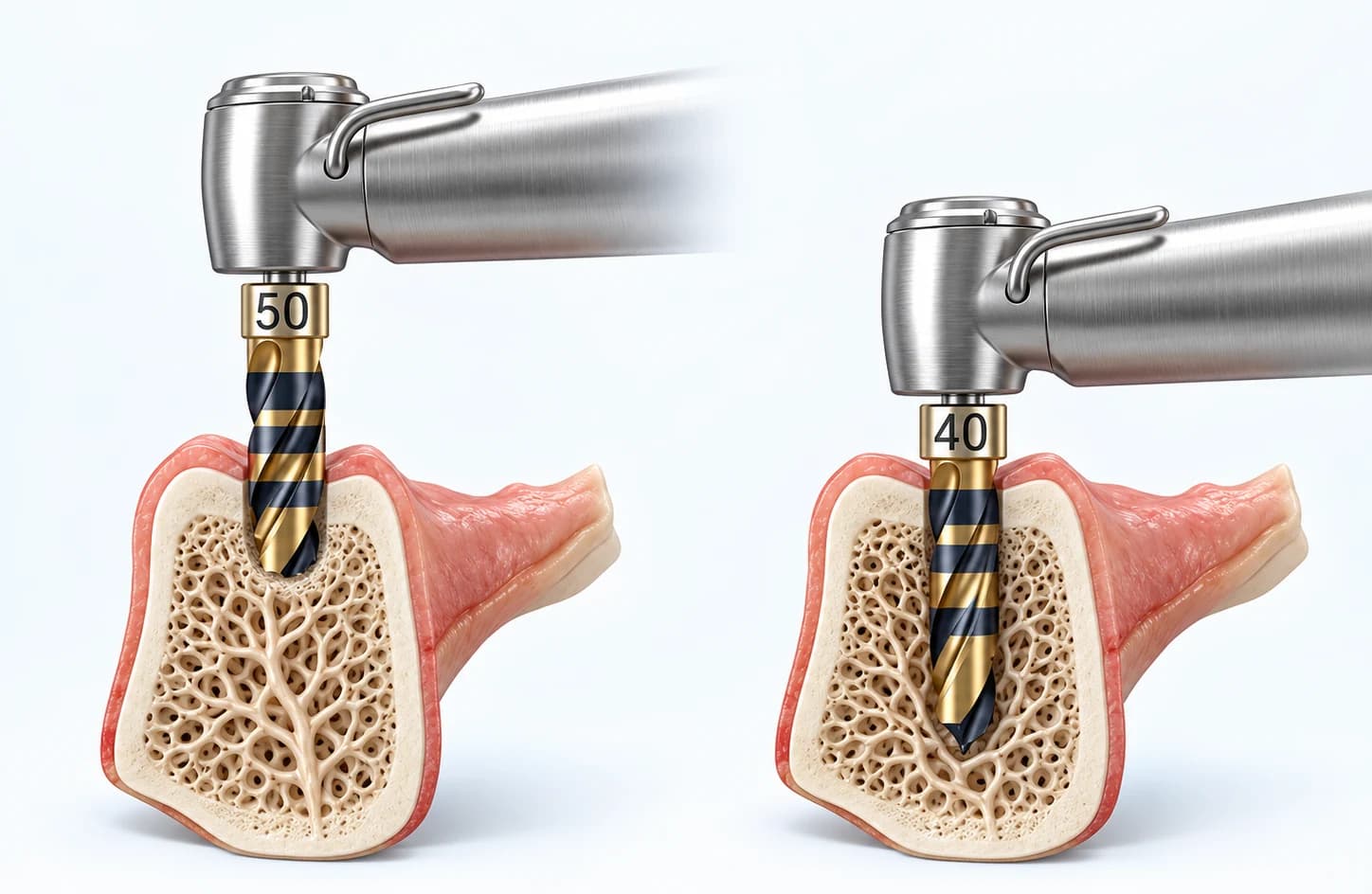
The Crown Down technique is a top-down osteotomy protocol that replaces conventional sequential drilling with a 2-step approach. Instead of using 5 to 8 drills of increasing diameter (pilot → intermediate → final), it prepares the complete implant site with two matched-diameter carbide instruments: the cortical drill engages crestal bone first, then a trabecular drill shapes the site to final dimensions.
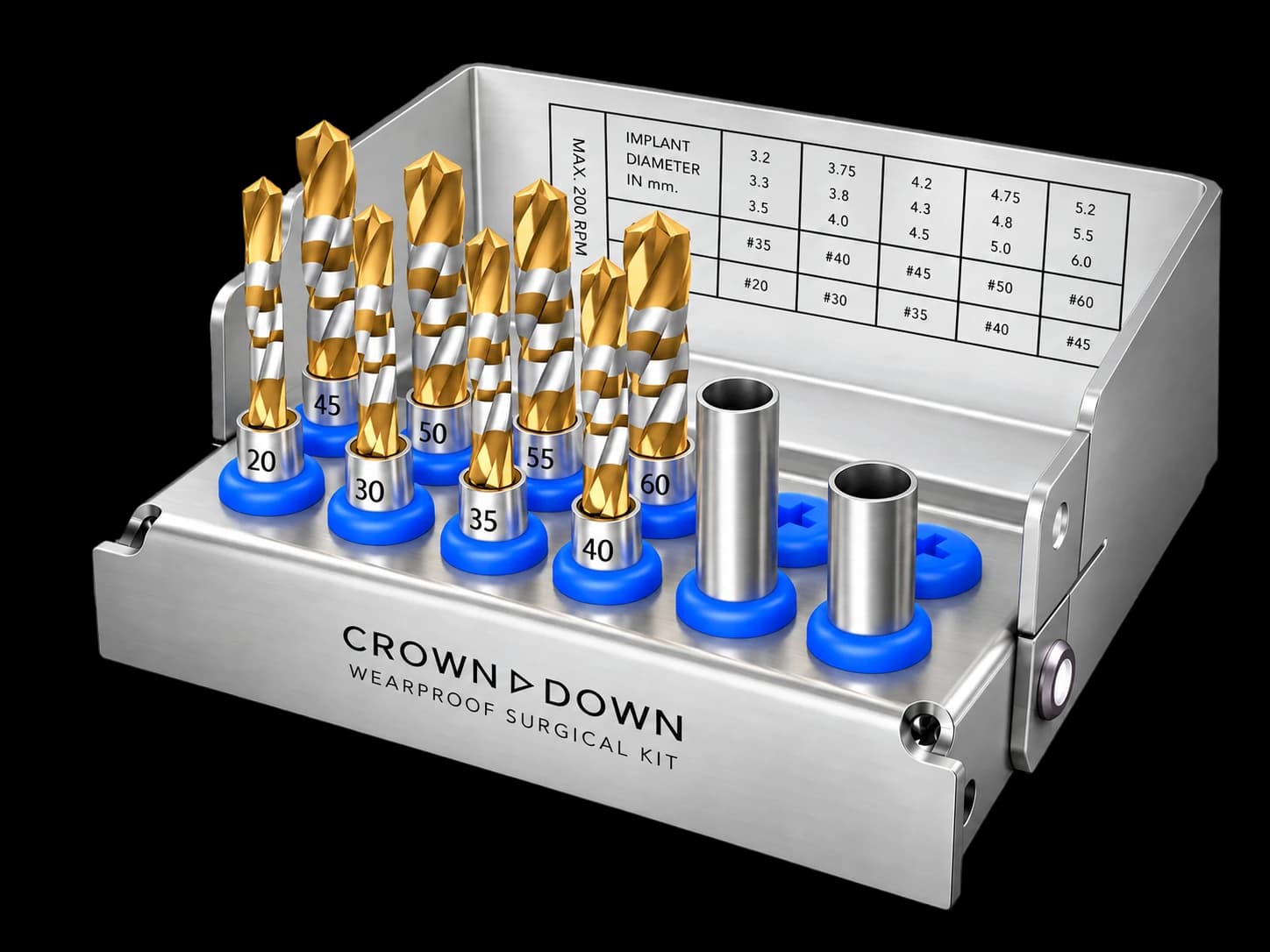
This is possible because the instruments are made from solid tungsten carbide (VP10X grade), a material hard enough (~1,600 HV30) to cut bone in a single pass at each stage, with thermal conductivity (110 W/m·K) high enough to manage heat without the progressive diameter increases that steel requires. The eight drills, two depth stoppers and a sizing chart ship together in the Crown Down implant drill kit.
The 2-step sequence
01 CorticalPreparation
02 TrabecularPreparation
Step 1 - Cortical engagement
Engage the crestal bone with a matched-diameter carbide instrument at low RPM. See the dedicated cortical drill page for geometry, diameter matching, and clinical rationale - this page covers where that instrument fits in the wider protocol.
Step 2 - Trabecular preparation
The second carbide instrument shapes the trabecular bone to the final osteotomy dimensions. The crown-down approach, starting from the crestal bone and working apically, preserves bone architecture and provides predictable primary stability.
Why do conventional implant protocols use more drills?
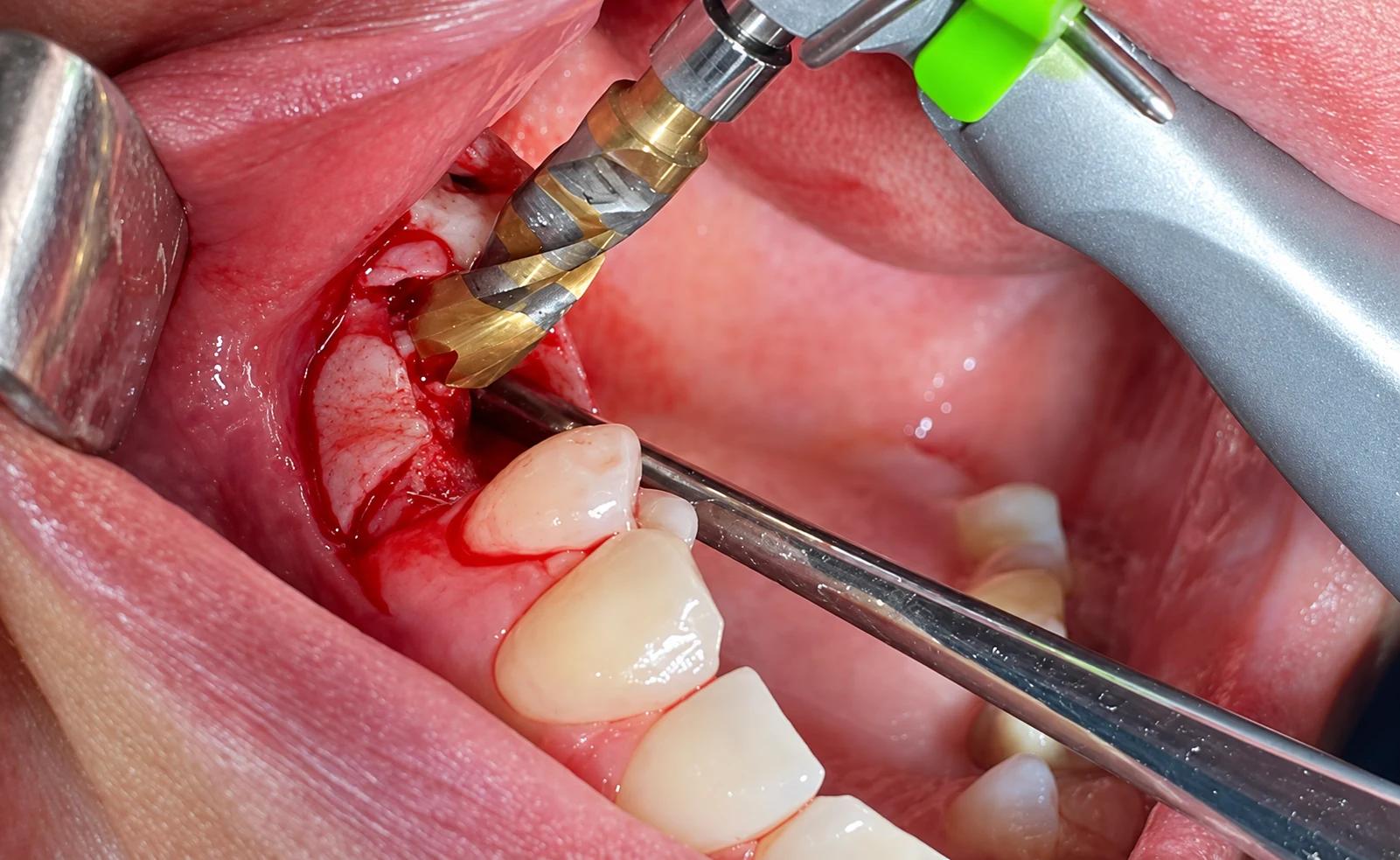
Standard implant drilling protocols are designed around the limitations of stainless steel. Because steel dulls quickly and doesn't dissipate heat well, manufacturers compensate by:
- Using small incremental diameter increases (0.5mm steps) to reduce force per pass
- Requiring copious irrigation to compensate for poor heat dissipation
- Mandating frequent drill replacement to maintain acceptable sharpness
The result is a 5 to 8 drill sequence that works around the material's weaknesses rather than leveraging material strengths. The Crown Down technique starts from a superior material and designs the protocol accordingly.
What are the clinical advantages of the Crown Down technique?
4×
Faster site preparation
Two drill changes instead of 4 to 8. Less instrument management, shorter procedures, more cases per day.
6×
Better heat dissipation
Tungsten carbide’s 110 W/m·K conductivity moves heat away from the cutting edge roughly 6× faster than stainless steel in comparative bench testing.
Enhanced
Tactile feedback
Clinicians consistently report improved perception of bone density changes during drilling, critical for technique adaptation and primary stability.
Preserved
Clean osteotomy walls
Fewer passes and lower measured drill-shank temperature mean less mechanical and thermal load on the osteotomy walls under the Crown Down bench protocol.
Is the Crown Down technique easier to learn than a conventional drilling protocol?
Most clinicians are comfortable with the Crown Down technique after a single session with the surgical implant kit. The protocol is simpler than conventional drilling: fewer instruments, fewer steps, and a straightforward cortical → trabecular sequence.
Want a walkthrough of the protocol or compatibility with your implant system? Book a quick call with our team and we'll cover it end to end.
Not just a product, a protocol
The Crown Down technique represents a fundamentally different approach to implant site preparation. It is not about making a better steel drill. It is about using a superior material to enable a superior protocol: fewer drills, less heat, faster procedures, and instruments that never need replacing. See the full range of dental implant drills and sizes.
Developed by Dr. Zvi Fudim after decades of clinical practice and materials science research, the Crown Down technique has been used by clinicians internationally with consistent results: cleaner osteotomies, preserved bone vitality, and predictable primary stability.
Frequently asked questions
Quick answers to questions clinicians ask most about this topic.
Keep reading
Related reading
Explore related pages on the Crown Down dental implant drilling kit, protocol, and clinical science.
Cortical Drill
Cortical Drill for Dental Implants
Drill #1 in the Crown Down 2-drill protocol: matched per implant diameter, used first to clear dense crestal bone.
Read moreProtocol
The 2-Drill Implant Osteotomy Protocol
How drill #1 and drill #2 prepare the implant osteotomy in two steps.
Read moreImplant Drill Kit
Tungsten Carbide Implant Drill Kit
What's inside the kit, the spec sheet, and the protocol it replaces.
Read more