



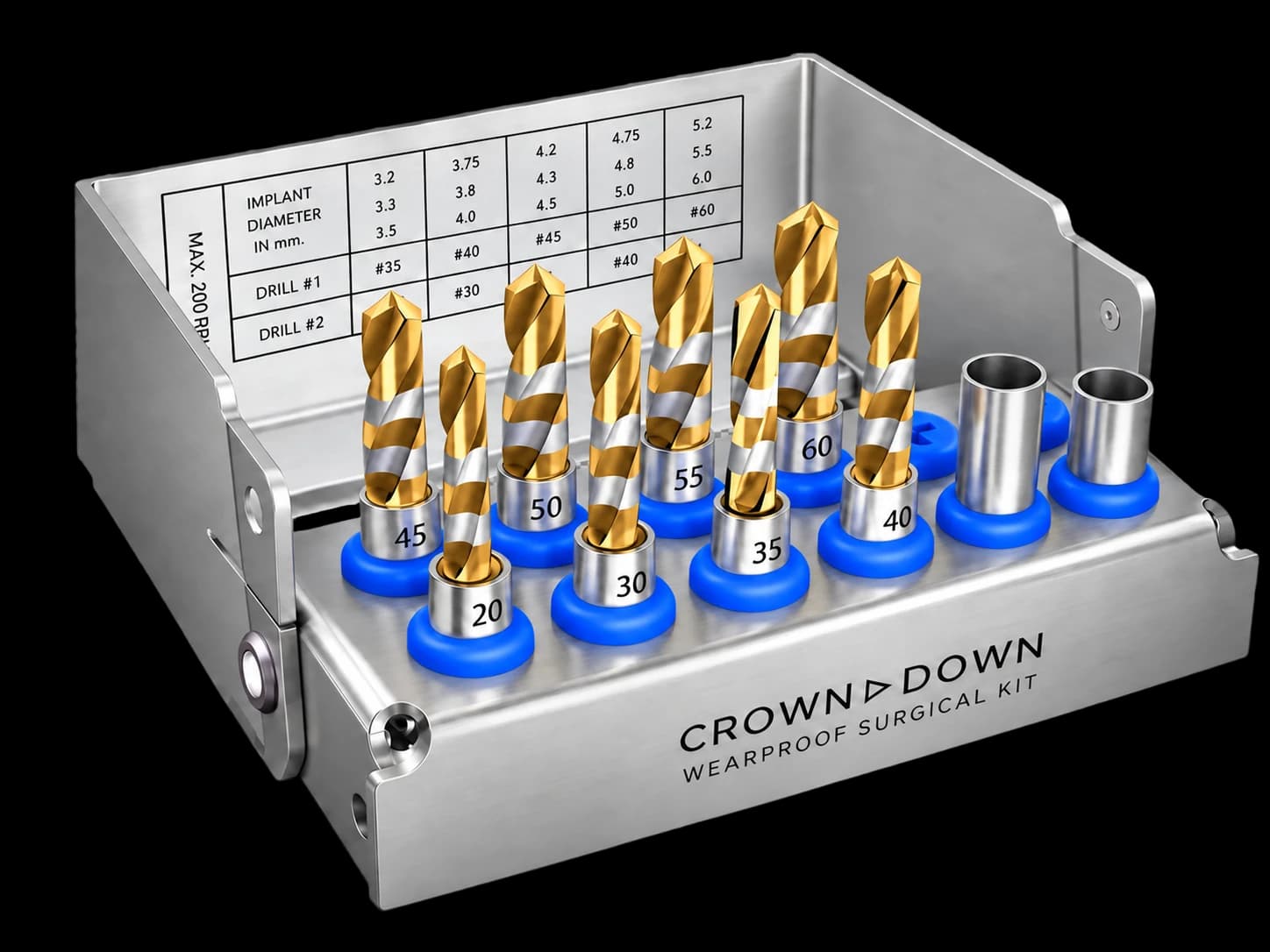
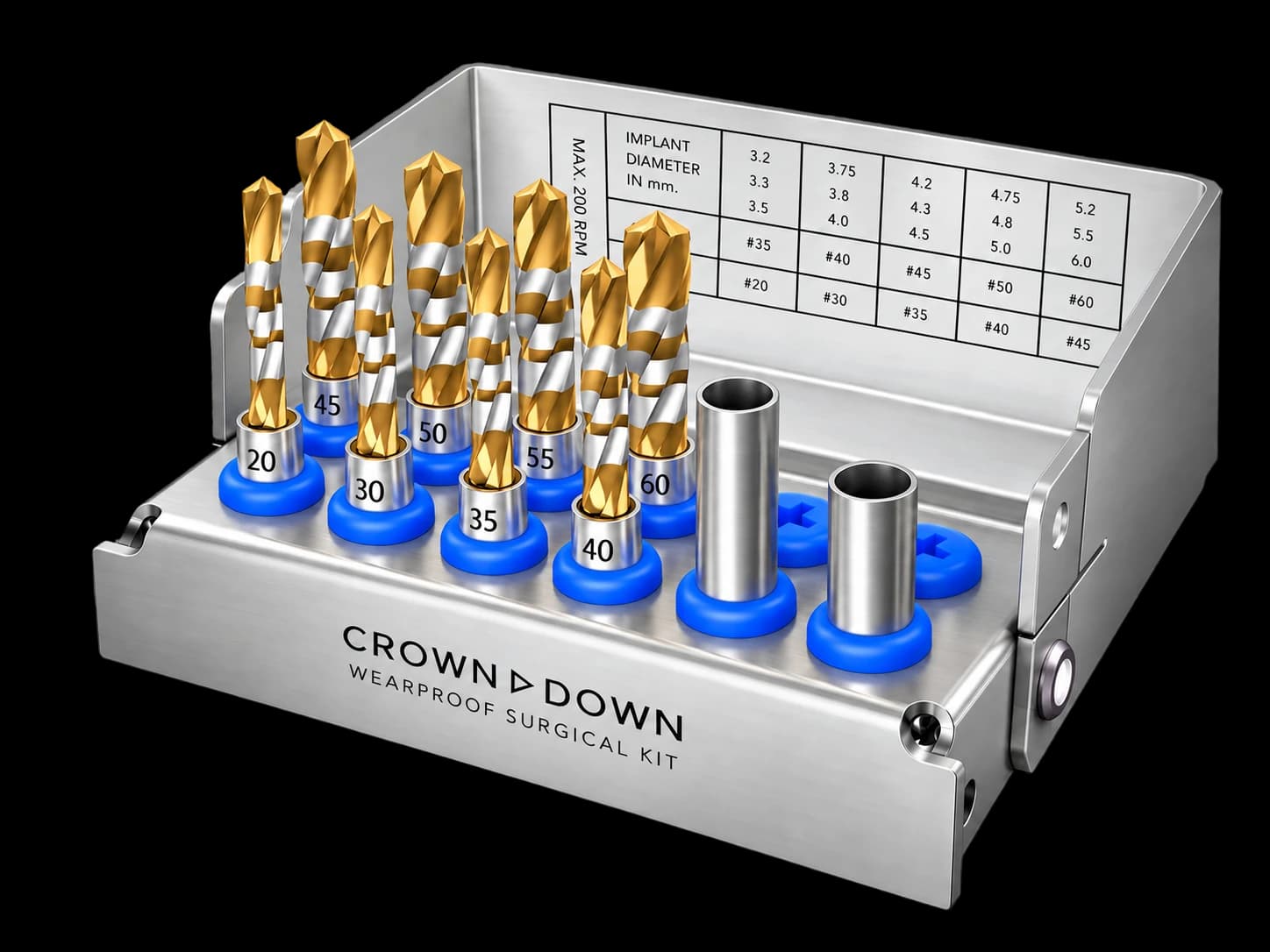
Guided Implant Drill Kit. Tungsten Carbide, Two Drills Per Site.
A guided implant drill kit built around the practical constraints of drilling through a surgical guide sleeve: fewer instrument handovers, coded depth stoppers that register 3-dimensionally against the sleeve, and tungsten carbide drills that don't depend on saline reaching the cutting edge through the guide.
The problem with a standard guided drill sequence.
A standard implant guided surgery kit ships with the same 5 to 8 sequenced steel drills used for freehand cases, plus a set of drill keys or spoons that key each drill to a matching sleeve diameter. In principle, that's a solved problem. In practice, running that sequence through a printed guide introduces three friction points that don't exist in a freehand case.
1. Instrument handovers scale with drill count.
Every drill change in a guided case is a physical handover: the surgeon disengages the current drill from the sleeve, swaps in the next diameter, re-engages the same sleeve, and confirms depth. Five to eight drills per site means five to eight of those handovers. Case time and fatigue both scale with the count, and every handover is an opportunity to lose the sleeve line-up.
2. Saline irrigation to the cutting edge is partially blocked.
The guide sleeve is a metal cylinder around the drill shaft. Saline irrigation from the handpiece doesn't reach the drill tip through that cylinder as cleanly as it does in an open freehand osteotomy. Slotted-shaft drills and internal-irrigation drills exist as workarounds, but the underlying issue is that saline arrives late and in reduced volume where you need it most. See heat in guided implant surgery for the underlying thermal argument.
3. Depth control depends on visual estimation.
Even with a well-designed guide, depth is often verified by watching the drill marking pass the coronal edge of the sleeve. A physical stopper that registers against the sleeve removes the visual step and stops the drill at the planned depth mechanically.
How Crown Down Handles Guided
Two drills, one set of coded stoppers, no saline dependency.
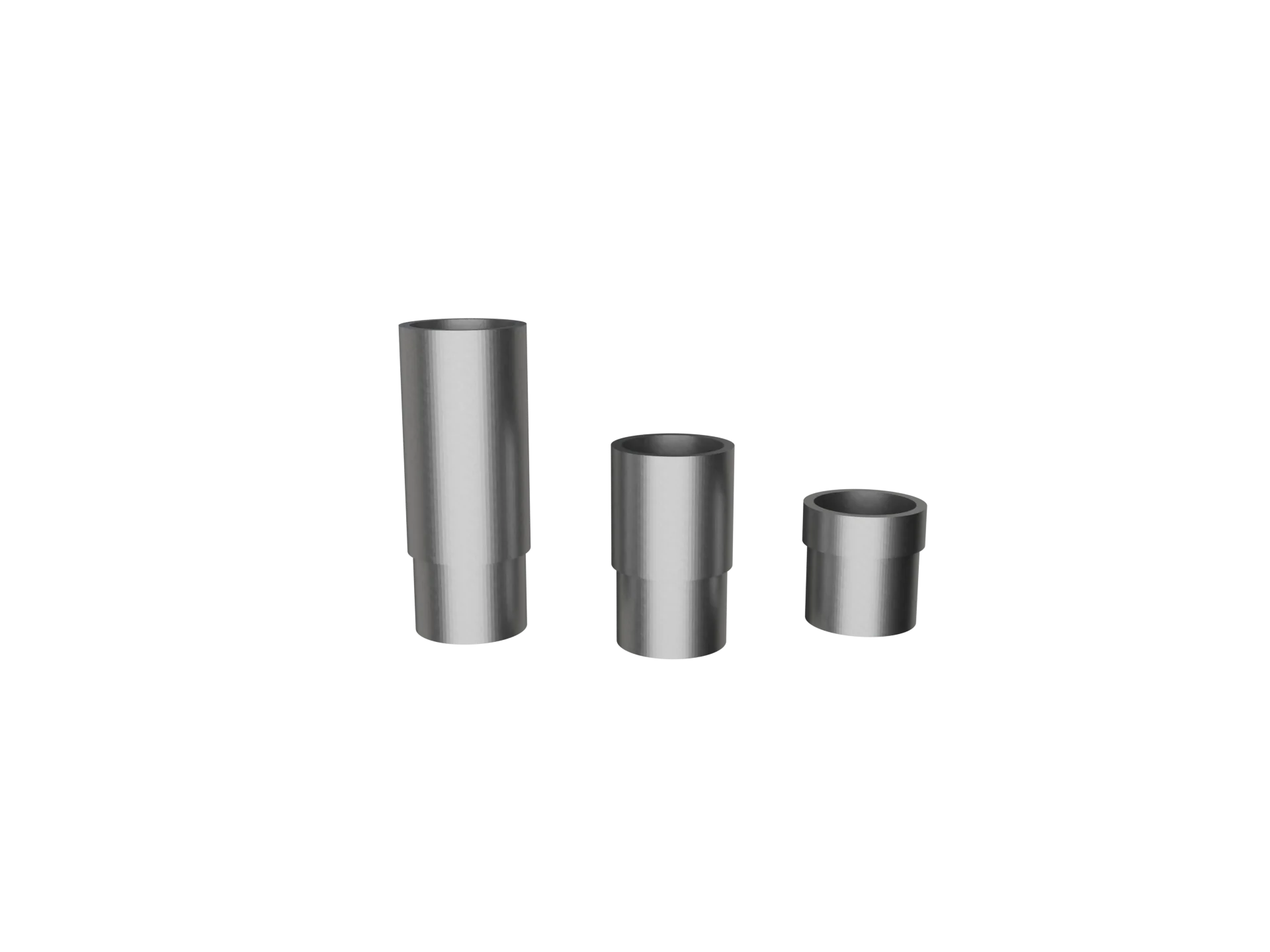
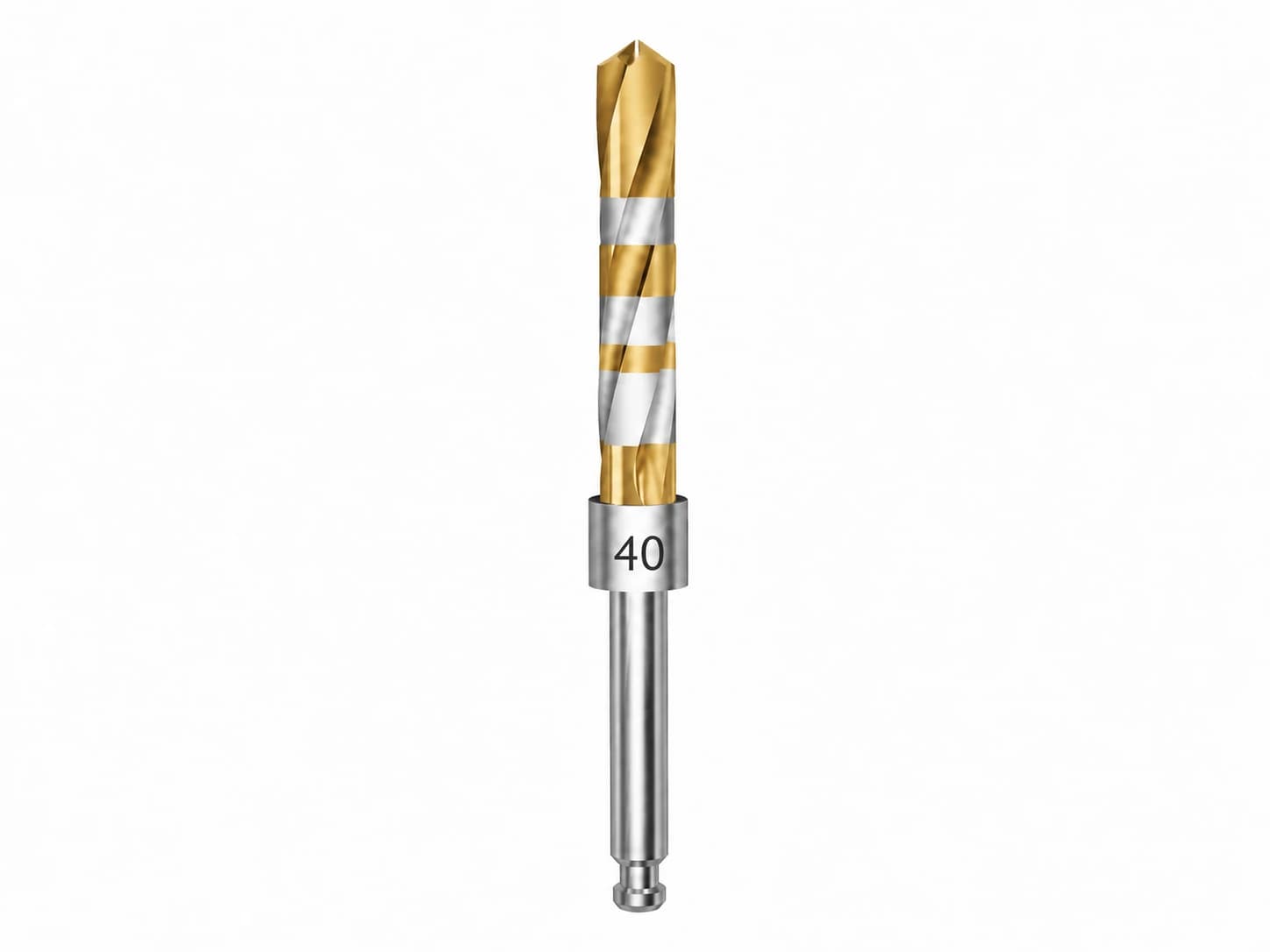
Crown Down handles the three friction points structurally, not incrementally. Drill count drops to two per site (one cortical, one trabecular), so through-sleeve handovers drop with it. Heat is managed by material: solid tungsten carbide has roughly six times the thermal conductivity of stainless steel, so the drill conducts heat up the shank and away from the osteotomy instead of relying on saline to reach the tip through the sleeve. And depth is set by coded 3D stoppers that seat against the coronal edge of the sleeve at 8, 10, or 12 mm, so the drill physically stops at the planned working depth.
The result is a guided workflow that reads more like a two-step procedure than a sequenced protocol: engage the cortical drill through the sleeve, complete with the trabecular drill, place the implant.

Crown Down 3D depth stoppers: 8, 10, 12 mm.
Compatible planning platforms and guide systems.
Crown Down does not ship a proprietary guide or planning software. The kit is engineered to work with any surgical guide that follows the standard metal-sleeve convention, which is nearly every guide on the market. Sleeve-diameter mapping and drill-body geometry are the two variables that govern compatibility; both are documented in the kit user manual.
coDiagnostiX
Straumann's planning platform. Most common workflow for guided BL / BLC cases.
DTX Studio / DTX Implant
Nobel Biocare's planning platform (formerly NobelClinician).
3Shape Implant Studio
Widely used with in-house 3D-printed guides.
Blue Sky Bio
Open-platform planning software with printed-guide export.
R2Gate
Osstem's fully-guided workflow with metal-sleeve guides.
Custom / in-house
Any guide with a standardized cylindrical metal sleeve is compatible.
Planning platform names are trademarks of their respective owners. Crown Down references these platforms only to document practical workflow compatibility; there is no partnership or endorsement.
A guided kit that also runs freehand.
Most guided-surgery kits on the market are configured for guided cases only, which forces the practice to maintain a second freehand tray. Crown Down runs the same 2-drill protocol either way. When the coded stopper is on the shank, the drill runs through the sleeve to the mechanically fixed working depth. When the stopper is off, the same drill runs freehand and depth is read from the laser-marked letter code on the drill body.
This matters practically: guided cases that need to convert to freehand mid-case don't require a tray change. All-on-X surgeries that run part-guided (posterior tilted implants planned around the sinus and inferior alveolar nerve) and part-freehand (anterior straight implants placed under direct vision) don't require two trays. And when a guide breaks or seats poorly, the case doesn't stop.
For the underlying protocol, see the 2-drill osteotomy protocol. For the material argument, see carbide vs steel implant drills. For pricing and the 5-year cost math against a conventional guided steel kit, see the drill cost calculator.
Frequently asked questions
Quick answers to questions clinicians ask most about this topic.
See the guided workflow end-to-end.
Book a clinical demo and we'll walk through the two-drill guided protocol on a live case setup, plus the coded stopper system, sleeve compatibility, and how a Crown Down tray sits in your existing guided-surgery workflow.
Keep reading
Related reading
Explore related pages on the Crown Down dental implant drilling kit, protocol, and clinical science.
Guided Surgery Heat
Heat in Guided Implant Surgery
Why irrigation through a guide sleeve falls short and how carbide heat conduction solves it.
Read more3D Stoppers
Crown Down 3D Drill Stoppers
Drill stoppers for guided implant surgery 3-dimensional drill control.
Read moreProduct Catalog
Crown Down 2026 Catalog
Every kit, drill, SKU, and stopper in one printable PDF reference.
Read more