Hands-On Training
DIY Implant Training with Bovine Ribs: A Practical Way to Build Tactile Confidence Between Courses
You have decided to expand your clinical services and begin placing implants. You may have completed one or more formal courses and still want more repetition before treating patients independently. That is normal - and bench practice on natural bone is how tactile confidence is built.

What is DIY implant training with bovine ribs?
The Crown Down Kit allows clinicians to practise drilling and implant insertion on bovine short ribs, a readily available natural-bone model. Unlike polyurethane training blocks, bovine short ribs contain both cortical and trabecular bone structures, which gives the operator a more realistic tactile experience of the two tissues the drill sequence is designed to prepare.
The kit’s solid tungsten-carbide drills are designed for repeated use, so it is practical to run frequent bench sessions without treating the drills as disposable training instruments. A package of short ribs generally costs about $10–$20, so each practice session can be inexpensive once the instruments and demonstration implants are already available.

How does DIY bench practice compare to formal implant courses on cost?
Formal live-patient implant courses are essential for accreditation and supervised clinical experience. But their cost and calendar make them impossible to attend every week, and tactile confidence deteriorates in the gaps between them. Bench practice at a fraction of the per-session cost is the mechanism that keeps the repetition curve continuous.
| Training program | Provider | Duration | Approx. cost (USD) |
|---|---|---|---|
| DIY bovine-rib practice | Crown Down Kit | Self-paced / repeatable | $10–$20 per session* |
| Level 1: Basic & Intermediate Implant Surgery | TCP Implant Marathon | 5 days | $14,950 |
| Implant Continuum: Fast Track | Implant Pathway | 5 days | $19,500 |
| Live Patient Implant Course | M.I.A.M.I. | 3 days | $13,950 |
| Mastering Implant Dentistry Fundamentals | Pikos Institute | 4 modules × 3 days | $19,996 |
*DIY cost represents bovine ribs only; it excludes the Crown Down Kit, motor, surgical components, personal protective equipment, and demonstration implants. Prices were checked on July 28, 2026 and may change. Course tuition and inclusions vary by provider. Always confirm current tuition, eligibility, travel requirements, and course inclusions directly with each provider.
Important
DIY bench practice is a supplementary exercise. It does not replace accredited education, supervised live-patient training, mentorship, or the licensing requirements of the jurisdiction where you practice.
How do you get demonstration implants for bench practice?
You do not need to buy clinical implants to practice insertion. The standard workflow is to contact implant-company representatives and ask whether they can provide opened, expired, or explicitly demonstration implants strictly for non-clinical bench training. Requesting examples from more than one implant system lets you compare drivers, insertion tools, connections, and per-system drilling workflows.
Clearly label and store all training components separately from your clinical inventory, and never use them in patients. Crown Down drilling protocols for the major implant systems are available in the compatibility section. If your implant system is not listed, request the appropriate protocol through the website’s contact form.
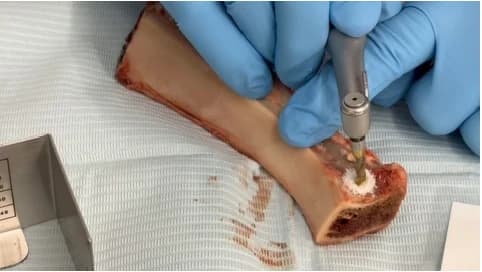
What is Clinical Perception, and how does bovine-rib practice develop it?
Bovine ribs provide a demanding natural-bone substrate. Repeated bench sessions on rib bone help the operator learn to recognize the transition from cortical to trabecular bone. This tactile feedback - referred to as Clinical Perception - supports two important learning objectives.
Objective 1
Recognizing changes in bone resistance
Feel the shift in resistance as the drill passes through the cortical layer and enters trabecular bone. Recognizing this transition intraoperatively is what makes drill-depth control possible.
Objective 2
Planning osteotomy preparation and primary stability
Develop a working sense of how bone density influences the preparation plan - especially in the cortical-first sequence used by the Crown Down 2-drill protocol.
Repeat bench exercises only within approved training protocols, following the Crown Down Kit instructions for use and the implant manufacturer’s instructions.
When are you actually ready to place implants in patients?
Bench training improves hand control and tactile awareness - but readiness for patient care requires far more than successful practice on ribs. Before independently placing implants, a clinician should have:
- Formal accredited implant education
- Supervised clinical experience under an experienced mentor
- Sound case-selection skills for the patient population you serve
- CBCT interpretation ability
- Established sterile technique and infection-control protocols
- Restorative planning that anticipates the prosthetic outcome
- Complication-management training (bleeding, sinus perforation, nerve proximity, primary-stability failure)
- Full compliance with the licensing and professional regulations of the jurisdiction where you practice
Use bovine-rib practice as repetition between courses and mentored clinical cases - not as a substitute for them.
How does bench practice bridge from education to supervised clinical care?
Implant drilling and placement can feel stressful at the beginning because confidence depends on repetition. Formal courses give you the theory and a few high-stakes hands-on hours; supervised clinical cases give you the real-patient reps; and bench practice fills the gap between them.
The Crown Down Kit gives clinicians a practical, low-cost way to repeat the drilling sequence on natural bone and refine tactile awareness between formal education milestones. Combined with mentorship and supervised cases, that repetition can make the transition from classroom learning to carefully supervised clinical care more structured - and less stressful when it matters.
Pricing sources
TCP Implant Marathon, Implant Pathway, M.I.A.M.I., and Pikos Institute provider websites (checked July 28, 2026). Always confirm current tuition, eligibility, travel requirements, and course inclusions directly with the provider.
See the Crown Down difference
One kit, two drills per site, and a wear-proof carbide system designed to eliminate routine drill replacement.
Frequently Asked Questions About DIY Implant Training
Common questions about bench practice, training costs, and getting ready to place implants.
Keep reading
Related reading
Explore related pages on the Crown Down dental implant drilling kit, protocol, and clinical science.
Protocol
The 2-Drill Implant Osteotomy Protocol
How drill #1 and drill #2 prepare the implant osteotomy in two steps.
Read moreBone Anatomy
Cortical vs. Trabecular Bone in Implant Surgery
Elasticity, rigidity, vascularization, and innervation of the two tissues - and why each requires its own drilling strategy.
Read moreCortical Drill
Cortical Drill for Dental Implants
Drill #1 in the Crown Down 2-drill protocol: matched per implant diameter, used first to clear dense crestal bone.
Read more