


1,000+
Cycle bone testing
Bovine rib, pig rib, and bovine tibia at 22°C. No visible wear observed across internal testing.
In-house bench testEvery implant chart records the implant that goes in. Almost none record the drill that shaped the site. So what happens by the 50th osteotomy on the same drill?
One Idea · Three Lenses
The same blind spot, viewed from three angles. Pick the lens that matches how your practice actually thinks.
Some practices log per-drill hole counts in the chart or on the cassette label. Most rely on the sterile-processing team to eyeball wear. Either is a legitimate answer. Not having one is also an answer.
Retirement rules differ by manufacturer and by drill type. Some publish a use count. Some publish an autoclave count. Some publish nothing. What does the drill kit you use today say, and where is it documented?
A single implant case can be one hole or four. If the manufacturer counts by patient, four adjacent osteotomies count as one use. If they count by site, the same case counts as four. Same drill, very different retirement math.
The Kit
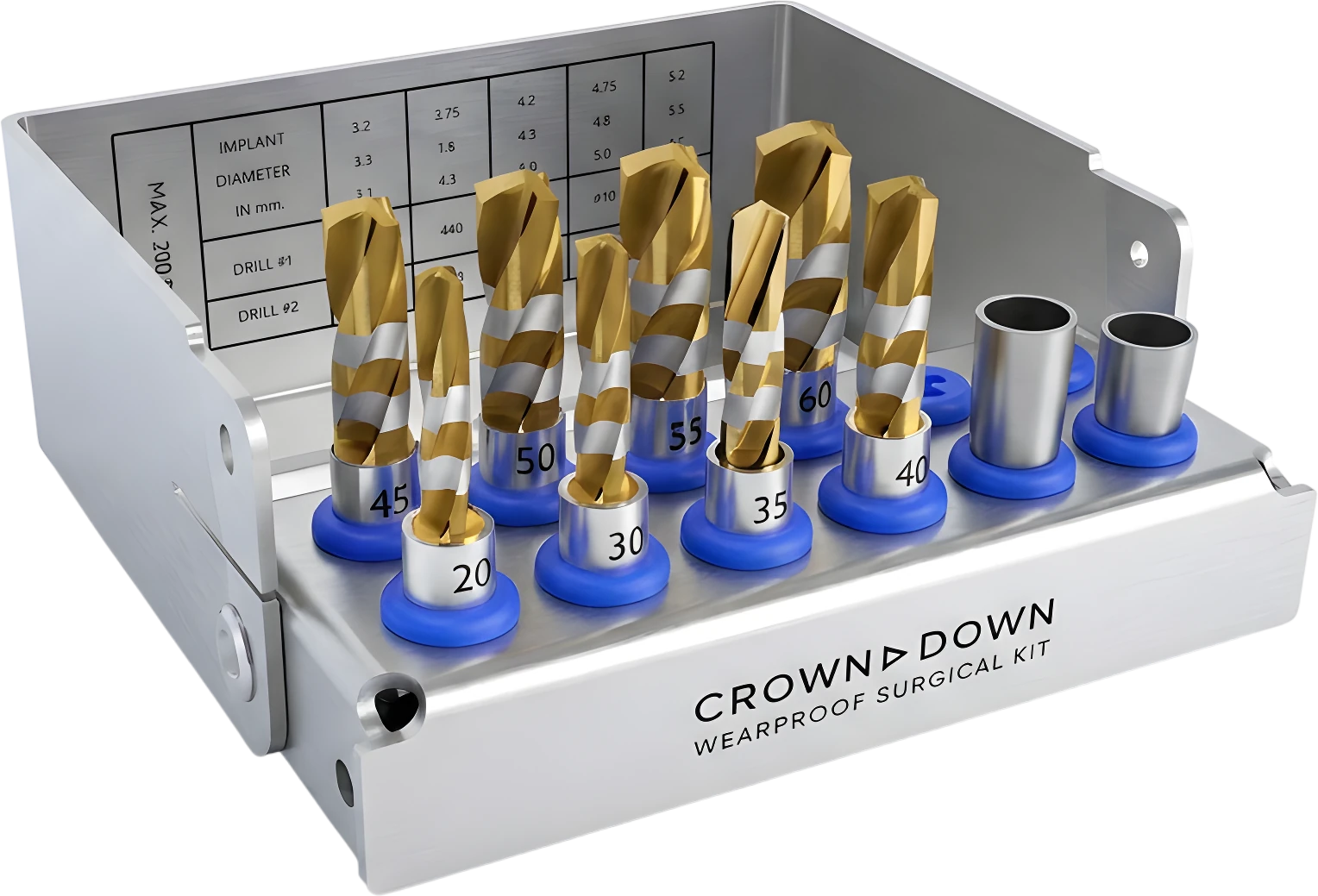
Eight solid tungsten carbide drills. A 2-drill protocol that runs guided or freehand. No replacement cycle to plan around, no drill-life math to reconstruct after the fact.
No replacement cycle
Cutting performance guaranteed for the life of the kit. No blind spot to worry about.
Solid tungsten carbide
Eight drills, ~13× harder than surgical steel.
Universal compatibility
Fits every major implant system: Nobel Biocare, Straumann, Zimmer Biomet, Neodent, BioHorizons, Dentsply Sirona, MegaGen, Osstem, and more.
15 or 20 mm lengths
Same 2-drill protocol, matched to your osteotomy depth.
Guided or freehand
3D depth stoppers lock into sleeved guides for planned cases. The same 2-drill sequence runs freehand when you don't have a guide. One kit, either workflow.
Or shop by SKU
Testing & Research
Three different classes of evidence, kept separate: in-house bench testing of Crown Down drills, independent peer-reviewed research on drill wear and heat, and documented clinical cases.
Bovine rib, pig rib, and bovine tibia at 22°C. No visible wear observed across internal testing.
In-house bench testKoo 2015, Mendes 2014, Harris & Kohles 2001, Yalcin 2025 on drill material, osteotomy heat, and repeated clinical use.
Independent researchOne documented Neodent GM case placed with the Crown Down protocol in a medically-compromised patient. Single-case observation, not systematic cohort follow-up.
Published case historyThe Drill Life Check
Most practices can’t answer that without checking. Four workflow questions. No patient information.
7 clinician reviews and counting
“Two years in and I haven't replaced a single drill.”
“I switched to Crown Down two years ago and haven't replaced a single drill. My implant site prep is noticeably faster and I have much better tactile feedback through the bone.”
Luxembourg
“My assistants noticed the difference on day one.”
“The 2-drill protocol cut my osteotomy time significantly. My assistants noticed the difference on day one: fewer instruments to manage, faster turnover between patients.”

Israel
“18 months of daily use and the drills still cut like new.”
“I was skeptical at first, but after 18 months of daily use the drills still cut like new. The heat reduction is real, and my patients report less post-op discomfort.”

Dominican Republic
“That line item is simply gone now.”
“What sold me was the economics. I used to budget for replacing dull drills every quarter, and that line item is simply gone now. The carbide holds its edge case after case, and the consistency that gives me during osteotomy prep is worth as much as the savings.”
Montreal, Canada
“My team adapted to the protocol within a week.”
“Going from a full sequential tray down to two drills changed how my surgical days run. There is less to set up, less to track, and my guided cases flow faster without sacrificing accuracy. My team adapted to the protocol within a week.”

Pierrefonds, Canada
“The thermal difference is something I can feel through the handpiece.”
“The thermal difference is something I can feel through the handpiece, and I see it in how cleanly the sites heal. Preserving bone vitality matters to me, and being able to collect autogenous chips on the same pass has made grafting in my practice far more straightforward.”
Dr. Gadi Kalihman
Kiryat Gat, Israel
“Same torque, different bone, different biology.”
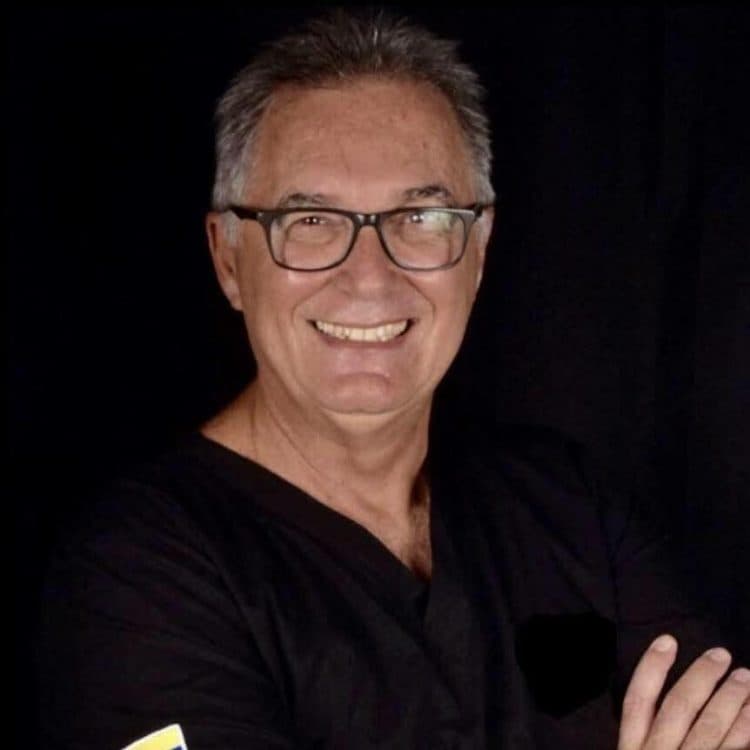
“This is one of the principles behind the Crown-Down technique: by selectively reducing cortical interference, insertion torque may better reflect the true mechanical contribution of the medullary bone while reducing excessive crestal compression. Same torque, different bone, different biology.”
Venezuela
Live Clinical Case
Two implant sites at lower right #45 and #47, prepared live with two tungsten carbide drills. No ascending sequence, no drill swaps between diameters.
Case by Dr. Ernesto Antonio Pichardo Tejada, DDS · 18+ months of daily Crown Down use
Matched-diameter drill clears the dense crestal cortex in seconds.
Trabecular drill completes the site, no ascending sequence.
The hardest bone type most clinicians will ever prepare.
Two adjacent osteotomies prepared with the same 2-drill sequence.
Buy With Confidence
Try it on your first cases. Full refund if it doesn’t outperform your current drills.
60-day clinical trial
Use the kit on your first cases. If Crown Down doesn't outperform your current drills, full refund - we pay return shipping.
Wear-performance for life
After the trial, drills are guaranteed against loss of cutting performance under normal clinical use.
FDA cleared
Class II surgical instrument. Regulatory documentation ships with every order.
Ships worldwide
$100 flat-rate shipping to every country we deliver to. Stripe checkout, tax at cart.
About Crown Down
Crown Down was designed by an implant surgeon to solve his own tray - fewer drills, no saline dependency, and cutting geometry that holds its edge across every osteotomy he places.

Meet the Founder
Founder & CEO · 30+ years, 6+ patents
Dental surgeon and inventor with three decades in implant dentistry. Crown Down is a system he built chair-side to solve a problem he kept running into himself - too many drills per site, too much saline, and steel edges that dulled long before the practice was ready to replace them.
Read the full bio30+
Years of implant surgery, patents, and chair-side iteration behind every drill.
1,000+
Cycle bone-block tests across bovine rib, pig rib, and bovine tibia at 22°C.
All majors
Universal compatibility across every major implant system, guided or freehand.
The Team
 Dr. Zvi FudimFounder & CEO
 John Ter-MesropianCo-Founder
 Ron FudimCTO
Four workflow inputs. Guidance located for your implant system, a transparent replacement-cost estimate, and one tracking gap worth discussing with your team. Sent back as a written summary, not a demo pitch.
Anonymous · No follow-up unless you ask
Contact
Want to see how much you'd save, join a call, or talk through compatibility with your implant systems? Book a call or send us a message and we respond within one business day.
Free 15-minute consultation • No commitment
We typically respond within one business day.